Shopify vs Teachable: Full Comparison (2026)
Detailed comparison of Shopify vs Teachable — pricing, ease of use, SEO, blogging tools, performance, and more. Find the best platform for your needs.
" transform="translate(1.5 0.5)" width="11px"/><path d="M 3.056 6 C 4.742 6 6.111 4.656 6.111 3 C 6.111 1.344 4.742 0 3.056 0 C 1.369 0 0 1.344 0 3 C 0 4.656 1.369 6 3.056 6 Z" fill="transparent" height="6px" id="lCf7utIFr" stroke-dasharray="" stroke-linecap="round" stroke-linejoin="round" stroke-width="1.2" stroke="rgb(30, 32, 35)" transform="translate(6.389 0.5)" width="6.111111111111086px"/></svg>)
Compare Platform
Setup & Migration
Key Takeaway
Shopify can be set up in around 30 minutes, while Teachable typically takes over an hour to get started.
Detailed Comparison
Shopify's estimated setup time of 30 minutes is notably faster than Teachable's 1+ hour onboarding process. Both platforms are rated as easy to moderate in terms of ease of use and support no-code setup, making them accessible without technical expertise. Where they differ is in migration tooling: Shopify supports both manual migration and app-based transfers, while Teachable relies on CSV-based imports.
| Features |
 Shopify
|
 Teachable
|
|---|---|---|
| Setup Time | 30 minutes | 1+ hours |
| Ease Of Use | Moderate ease | Easy to moderate |
| Migration Tools | Manual, app | CSV-based |
| No Code | Yes | Yes |
| Blog Setup via DropInBlog | Embed in minutes | Embed in minutes |
Compare Platform
Customization and Performance
Key Takeaway
Shopify offers significantly more theme options and full CSS access, while Teachable provides a more streamlined but limited customization experience.
Detailed Comparison
Shopify provides 220+ switchable themes alongside full custom CSS access, compared to Teachable's 3 switchable themes and limited CSS control. Both platforms include hosting on all plans and offer built-in or automatic mobile optimization. Speed performance on Shopify depends on the chosen theme and installed apps, whereas Teachable's speed is platform-optimized by default.
| Features |
Shopify
|
Teachable
|
|---|---|---|
| Theme Flexibility | 220+ themes, switchable | 3 themes, switchable |
| Custom Css | Full access | Limited access |
| Speed Optimization | Depends on the platform, theme, apps | Platform-optimized |
| Mobile Optimization | Built-in | Automatic |
| Hosting | Included in all plans | Included in all plans |
| Blog Design (DropInBlog) | Pre-made layouts + Full CSS control | Pre-made layouts + Full CSS control |
Compare Platform
Blogging and SEO
Key Takeaway
Shopify includes a built-in blogging tool, while Teachable has no blogging feature at all.
Detailed Comparison
Shopify comes with a built-in blogging tool and a point-and-click WYSIWYG editor, whereas Teachable offers no blogging functionality and uses a block-based editor for its content. Both platforms provide basic built-in SEO features. Schema markup is built in (though limited) on Shopify, while Teachable requires it to be added manually.
| Features |
Shopify
|
Teachable
|
|---|---|---|
| Blogging Tools | Built-in blogging tool | No blogging feature |
| Seo Features | Basic built-in SEO | Basic built-in SEO |
| Editor Type | Point-and-click, WYSIWYG | Block-based |
| Schema Support | Built-in, limited | Must be added manually |
| SEO analysis (DropInBlog) | SEO Analyzer + Mention Boost™ (helps get cited by AI) | SEO Analyzer + Mention Boost™ (helps get cited by AI) |
Boost SEO and AI Mentions:
DropInBlog + Shopify or Teachable
Add a powerful blog to Shopify or Teachable in a few clicks. DropInBlog comes packed with features that help you rank in Google, ChatGPT, and other SERPs.
Pro Tip
Compare Platform
Platform Ecosystem and Integrations
Key Takeaway
Shopify's marketplace of 13,000+ apps vastly outnumbers Teachable's 20 available integrations.
Detailed Comparison
Shopify operates on a modular ecosystem model with access to over 13,000 apps and broad third-party integration support, along with full API access. Teachable takes an all-in-one approach, offering around 20 apps and limited third-party integrations, with API access also described as limited. The difference in ecosystem scale reflects each platform's underlying model rather than a gap in core functionality.
| Features |
Shopify
|
Teachable
|
|---|---|---|
| Plugin Marketplace | 13,000+ apps | 20 apps |
| Third Party Integration | Broad | Limited |
| Ecosystem Model | Modular | All-in-one |
| Api Access | Yes | Limited |
| DropInBlog Integration | Quick & Simple | Quick & Simple |
DropInBlog
DropInBlog is the top way to boost SEO and AI Mentions on Shopify and Teachable. A tight integration makes it the best choice for blogging on either platform.
Top Integration
Compare Platform
Cost and Support
Key Takeaway
Shopify starts at $29/month, while Teachable's entry price is $89/month — nearly three times higher.
Detailed Comparison
Shopify's plans start at $29/month, and its typical cost remains at that same tier. Teachable starts at $89/month, with a typical cost of $189/month. Neither platform offers a free plan. On the support side, Teachable provides email, live chat, and a knowledge base — including chat and phone options on paid plans — while Shopify's support is limited to a knowledge base and community resources, with no chat or phone support.
| Features |
Shopify
|
Teachable
|
|---|---|---|
| Starting Cost | $29/month | $89/month |
| Typical Cost | $29/month | $189/month |
| Free Plan | No | No |
| Support Type | Knowledge base + community | Email + live chat + knowledge base |
| Chat Phone | No | Yes (on paid plans) |
| Blog & SEO Customer Support | Available with DropInBlog | Available with DropInBlog |
" transform="translate(4.267 1.654)" width="8.467931642613546px"/></svg>)
Features
Teachable Pros and Cons
Best for: course creators, coaches and educators wanting to build and sell online courses or coaching programs with minimal technical setup
Pros
drag‑and‑drop course builder with video, quizzes and downloads support
built‑in payment and checkout system avoids external setup
intuitive interface suited to non‑technical users
supports multiple product types including courses, coaching, digital downloads and memberships
Cons
limited design and website customization beyond basic pages and templates
not built for full content sites or complex websites
feature limitations and restrictions on lower pricing tiers
scaling a large school with many courses can become cumbersome
Features
Shopify Pros and Cons
Best for: online retailers, small to medium‑size shops and entrepreneurs needing a full‑featured, scalable ecommerce platform with minimal setup overhead
Pros
ready‑to‑use store builder with hosting and checkout built in
supports unlimited products and multichannel selling including online store, social and POS
large app ecosystem enables extending functionality without custom code
robust inventory, order and shipping tools simplify store operations
Cons
higher ongoing cost when factoring transaction fees, paid apps and premium themes
design and customization flexibility is more limited than custom or self‑hosted solutions
reliance on third‑party apps for many advanced features increases management complexity
migrating out is cumbersome and often leads to data loss or manual rebuild
Issues
Known Limitations
Even the best platforms have tradeoffs. Here's what to watch out
for with Shopify and Teachable.

Shopify
Shopify’s hosted ecommerce architecture and reliance on its own ecosystem make it difficult to port a store elsewhere and limit deep customization or unique backend logic for advanced or highly bespoke shops.
Teachable
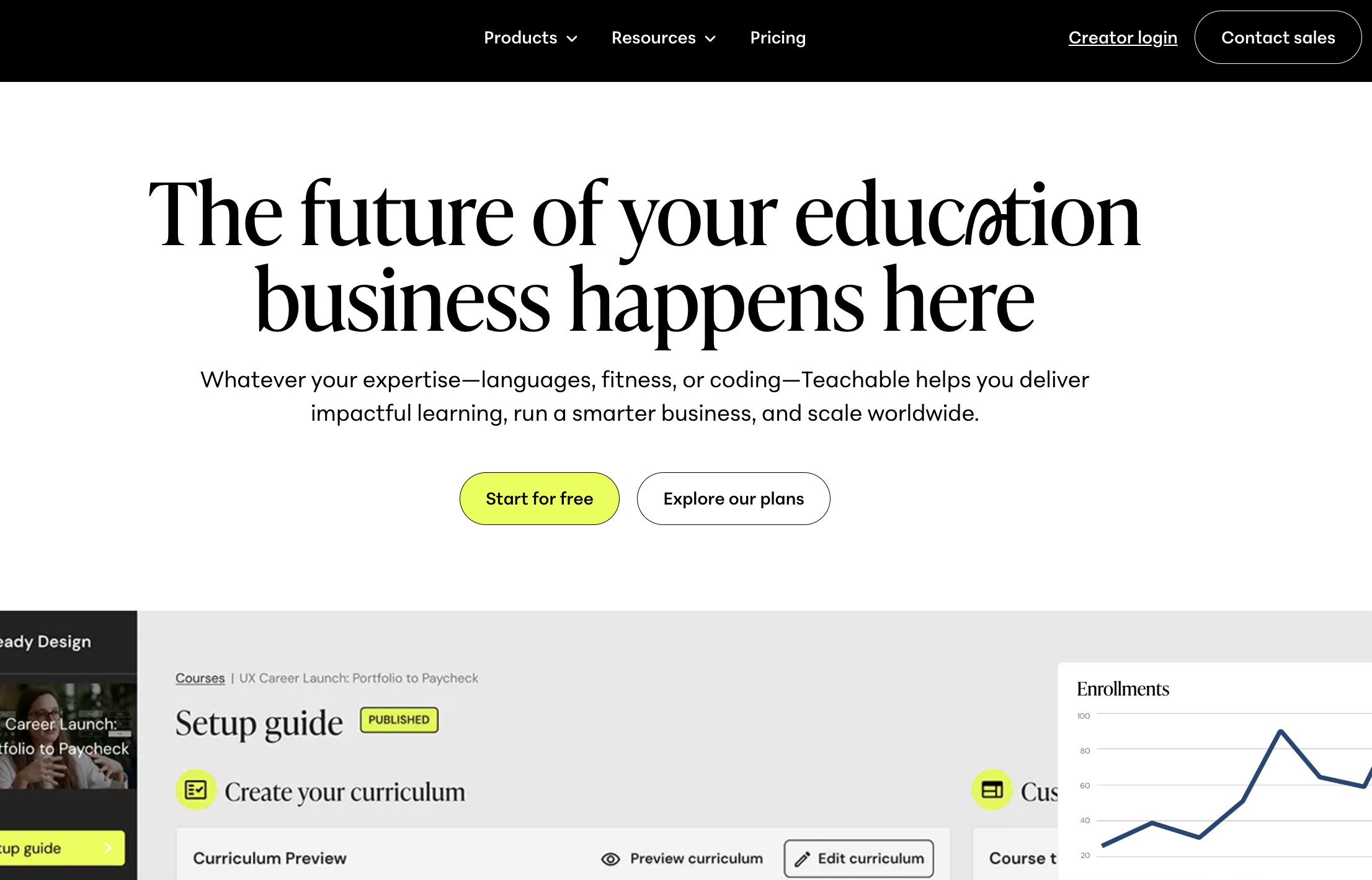
Teachable’s course‑and‑page‑centric architecture and limited site flexibility make it unsuitable for complex, content‑heavy websites or projects requiring deep customization or full control over design and infrastructure.
Comparison Chart
Teachable vs. Shopify: Feature Comparison at a Glance
A quick score-by-score breakdown of how Shopify and Teachable stack up across key blogging features.
Setup & Migration
Customization and Performance
Platform Ecosystem and Integrations
Cost and Support
SEO and Blogging*
10
8
6
4
2
0
Shopify
Teachable
*SEO and Blogging scores reflect DropInBlog integration, where both platforms score 10/10.
" transform="translate(5.203 5.015)" width="5.667921508455159px"/><path d="M 10.963 3.648 C 11.431 4.866 11.466 6.205 11.062 7.445 C 10.665 8.685 9.851 9.748 8.76 10.456 C 7.669 11.165 6.372 11.484 5.083 11.342 C 3.793 11.207 2.589 10.633 1.668 9.712 C 0.754 8.791 0.173 7.58 0.031 6.29 C -0.104 4.994 0.201 3.69 0.91 2.599 C 1.611 1.508 2.674 0.686 3.907 0.282 C 5.139 -0.122 6.478 -0.093 7.69 0.374" fill="transparent" height="11.374799430541554px" id="hkzee8Fiz" stroke-dasharray="" stroke-linecap="round" stroke-linejoin="miter" stroke-miterlimit="10" stroke-width="1.6" stroke="rgb(30, 32, 35)" transform="translate(2.373 2.175)" width="11.341380903273622px"/><path d="M 4.931 0 L 0 4.952" fill="transparent" height="4.95233697147681px" id="MyGBPOHPD" stroke-dasharray="" stroke-linecap="round" stroke-linejoin="miter" stroke-miterlimit="10" stroke-width="1.6" stroke="rgb(30, 32, 35)" transform="translate(8.044 2.911)" width="4.93108226582032px"/><path d="M 2.125 2.125 L 0 2.125 L 0 0" fill="transparent" height="2.125470565670791px" id="uwpXBFmdG" stroke-dasharray="" stroke-linecap="round" stroke-linejoin="miter" stroke-miterlimit="10" stroke-width="1.6" stroke="rgb(30, 32, 35)" transform="translate(12.996 0.8)" width="2.1254705656706694px"/></svg>)









" transform="translate(8.972 11.235)" width="1px"/><path d="M 12.75 6.375 C 12.75 2.854 9.896 0 6.375 0 C 2.854 0 0 2.854 0 6.375 C 0 9.896 2.854 12.75 6.375 12.75 C 9.896 12.75 12.75 9.896 12.75 6.375 Z" fill="transparent" height="12.749995277777776px" id="G1LqZeWyx" stroke-dasharray="" stroke-linecap="round" stroke-linejoin="round" stroke-width="1.23" stroke="rgb(30, 32, 35)" transform="translate(1.889 1.861)" width="12.75px"/><path d="M 0 0.706 C 0.227 0.465 0.489 0.274 0.793 0.154 C 1.091 0.033 1.424 -0.016 1.75 0.005 C 2.083 0.033 2.394 0.125 2.678 0.288 C 2.961 0.451 3.202 0.685 3.379 0.954 C 3.556 1.23 3.676 1.535 3.726 1.868 C 3.761 2.186 3.74 2.526 3.634 2.831 C 3.542 3.136 3.365 3.433 3.138 3.653 C 2.904 3.886 2.628 4.064 2.316 4.177" fill="transparent" height="4.176867474042281px" id="nR8CIIsAJ" stroke-dasharray="" stroke-linecap="round" stroke-linejoin="round" stroke-width="1.23" stroke="rgb(30, 32, 35)" transform="translate(6.158 4.954)" width="3.7416656420466814px"/></svg>)
FAQ
Still Have Questions? Check the Answers
What is DropInBlog?
DropInBlog is the leading way to add a full-featured blog to your existing website without using WordPress. It’s quick to set up, blends with your site’s design, and is built for great SEO.
How does DropInBlog integrate with my website?
DropInBlog can be integrated in minutes by pasting just a couple of lines of code or using our app for most site builders. For advanced users, there is a full JSON API.
Can DropInBlog match the style of my current website?
DropInBlog seamlessly integrates with your existing website design, ensuring consistency in style and layout. With the Design Customization option, you have the freedom to easily tweak several design elements such as fonts and link colors.
What are the key features of DropInBlog?
Key features include seamless integration with site design, listen-to-article player, various SEO tools, help with AI mentions, easy-to-use interface, and friendly customer support. See all the features of DropInBlog on the Features page.
" transform="translate(3.996 5.461)" width="6px"/><path d="M 11.605 3.861 C 12.1 5.151 12.138 6.569 11.71 7.881 C 11.29 9.194 10.428 10.319 9.273 11.069 C 8.118 11.819 6.745 12.156 5.38 12.006 C 4.015 11.864 2.74 11.256 1.765 10.281 C 0.798 9.306 0.183 8.024 0.033 6.659 C -0.11 5.286 0.213 3.906 0.963 2.751 C 1.705 1.596 2.83 0.726 4.135 0.299 C 5.44 -0.129 6.858 -0.099 8.14 0.396" fill="transparent" height="12.041263317683857px" id="y87LrscfG" stroke-dasharray="" stroke-linecap="round" stroke-linejoin="miter" stroke-miterlimit="10" stroke-width="1.5" stroke="rgb(30, 32, 35)" transform="translate(1 2.457)" width="12.005900591728873px"/><path d="M 5.22 0 L 0 5.242" fill="transparent" height="5.24249px" id="nbsOQfjzg" stroke-dasharray="" stroke-linecap="round" stroke-linejoin="miter" stroke-miterlimit="10" stroke-width="1.5" stroke="rgb(30, 32, 35)" transform="translate(7.002 3.234)" width="5.21995px"/><path d="M 2.25 2.25 L 0 2.25 L 0 0" fill="transparent" height="2.25px" id="rwINJ9lwj" stroke-dasharray="" stroke-linecap="round" stroke-linejoin="miter" stroke-miterlimit="10" stroke-width="1.5" stroke="rgb(30, 32, 35)" transform="translate(12.246 1)" width="2.25px"/></svg>)
Solution
“We swapped our :platform1 blog for DropInBlog and saw a dramatic improvement in speed, simplicity, and SEO – without sacrificing any flexibility.”

Marissa L.
Founder of BoldPress
If you’ve made it this far, you’re probably doing what most teams do: trying to pick the right platform before you commit. You also want a site that actually drives traffic, leads, and growth.
That’s exactly why DropInBlog exists. It’s the simplest way to add a serious content engine to :platform2, :platform1, or your existing site builder, so you can launch a powerful, SEO-friendly blog today.
If you want the most straightforward path to content marketing that performs, DropInBlog is the next step. Try it free or book a quick demo and we’ll help you get set up.