
A customer came to us last week wanting to add a blog to their site. Reasonable ask, except they'd already signed up for one of those "fully managed" AI SEO tools, and they just needed help hooking it up.
So we looked under the hood. And what was coming out the other end wasn’t offensively bad, but that's the trap. It was worse; it was fine.
Smooth, grammatical, confident, and completely interchangeable. Every post opened with the same throat-clearing intro. Every "guide" answered a question nobody had asked in a way that helped no one. Swap one keyword for another, and the same article worked for a plumber, a SaaS company, or a dog groomer.
It wasn't content, it was content-shaped filler, produced at a rate no human could match.
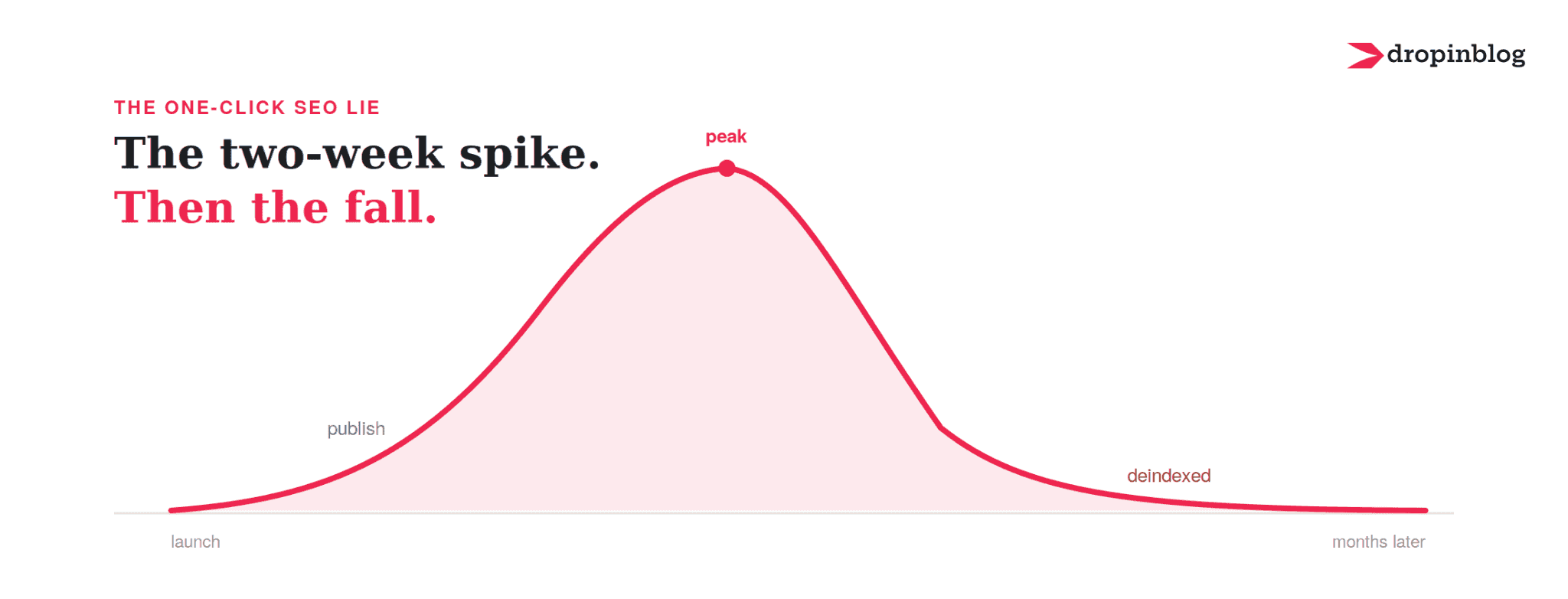
We see the harm these tools cause constantly, and it's half the reason we built Blog Pilot™ the way we did, so I have my own opinions, but I'll let the data carry them.
For a few weeks, it really does look like it's working
This is what makes these tools so easy to sell. They aren't obviously broken at first. They publish fast, target low-competition long-tail keywords, and Google will happily index a lot of it. Impressions climb in Search Console, pages get crawled, and you start ranking for hundreds of queries you weren't ranking for before. It feels like momentum.
The clearest picture of what comes next is a 16-month experiment by SE Ranking's research team, published on Search Engine Land in early 2026. They bought 20 brand-new domains, with no authority, no backlinks, and no history, and published 2,000 fully AI-generated articles across them with no human editing whatsoever. Then they left them alone and tracked what Google did.
The early numbers were genuinely good. Within about five weeks, roughly 71% of the pages were indexed. In the first month, the sites pulled in over 122,000 impressions, and 80% of them ranked for at least 100 keywords each. By two and a half months, cumulative impressions had crossed half a million. Anyone checking the dashboard at that point would have called it a success and bought the annual plan.
Then it collapsed. By around three months, only 3% of pages still ranked in the top 100, down from 28% in the first month. The pages stayed indexed; users simply stopped seeing them. Google had tested the content, found nothing underneath it, and quietly stopped surfacing it. Across the full 16 months, the sites never meaningfully recovered. Around 70–75% of every impression they ever earned came in those first two and a half months.
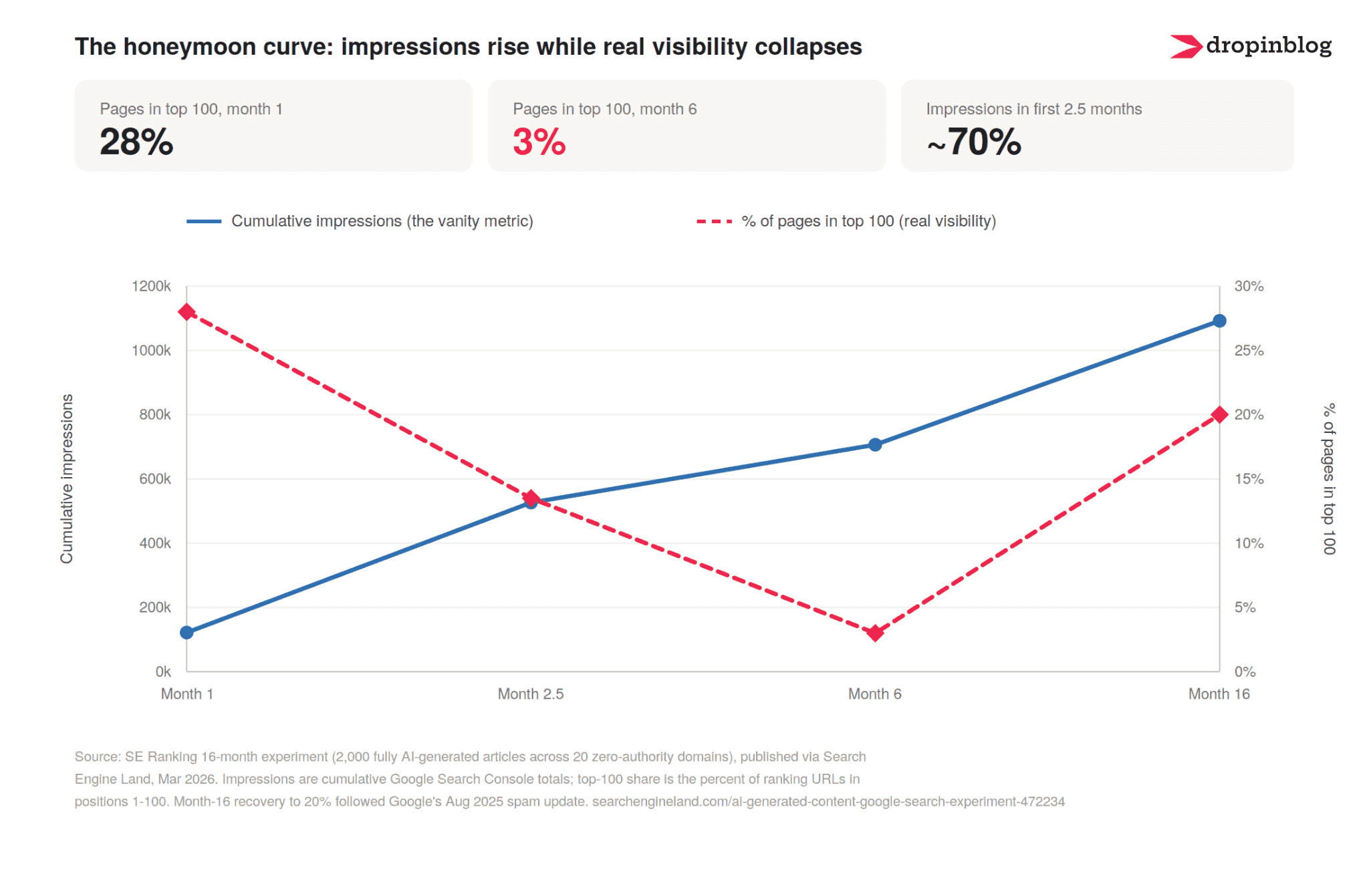
That's the trap. The metric you watch (impressions) keeps climbing the whole time, so the dashboard looks like a success story right up to month 16. But the metric that pays the bills (pages actually ranking where people look) had already collapsed by month three. That traffic spike is a loan, not income, and the dashboard is very good at hiding the repayment.
This isn't just a lab result, it's happening to real sites right now
A controlled experiment is persuasive, but you might reasonably ask whether it holds up in the wild, on real businesses with real stakes. It does.
Lily Ray, VP of SEO Strategy and Research at Amsive, did something methodical: she tracked more than 220 websites that had publicly identified themselves as customers of AI content creation platforms, tools that fully write articles, assist with writing, or run the whole workflow on autopilot. Then she watched what happened to their traffic over time.
The pattern was so consistent she gave it a phrase: "it works, until it doesn't." Rapid early growth, then an equally rapid collapse, what fellow analyst Glenn Gabe has been calling "Mount AI." The climb looks like a winning strategy right up until it becomes the cliff.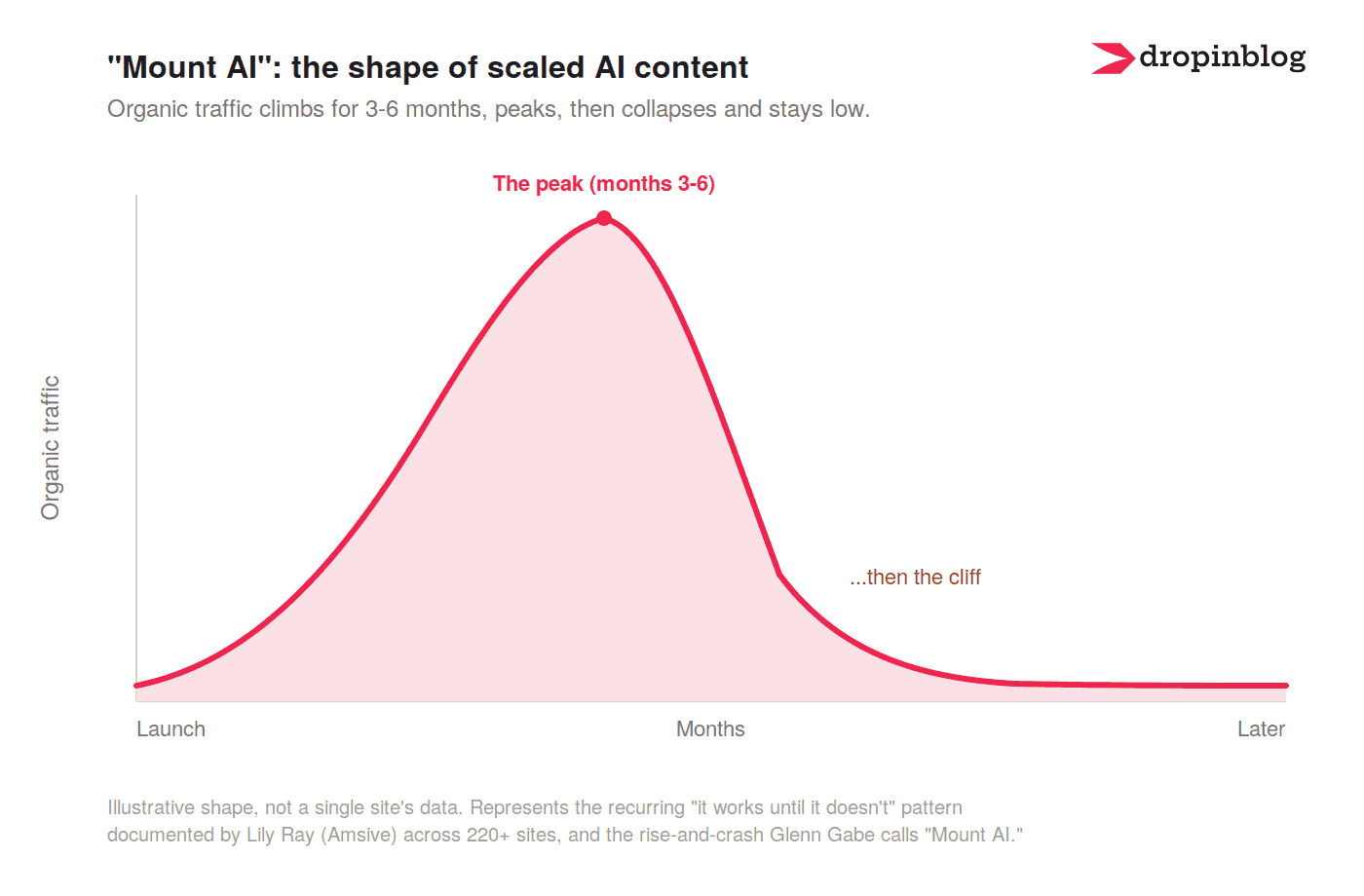
Ray is careful about her data, and so am I: these are third-party traffic estimates, not first-party analytics, and there can be other factors behind any single site's decline. But the pattern repeats across hundreds of sites and lines up exactly with the controlled experiment, so when the lab result and the field data tell the same story, it's worth listening.
Google never said AI was the problem
Here's where most warnings about "AI slop" go off the rails, so I want to be precise.
If you've been told Google penalizes AI content, that isn't true, and the data is unambiguous. Ahrefs analyzed 600,000 pages and found that the correlation between how much AI a page contained and how well it ranked was 0.011. Statistically, that's zero.
Their data even suggests the very top-ranking pages tend to contain slightly less AI, which points to the real pattern: the best content isn't AI-free, it's AI-assisted, with a human still steering. Most high-performing content today has some AI in it, so the tool isn’t the problem.
So if Google isn't punishing AI, what killed those sites? Google's own policy answers it. In its March 2024 update, Google defined a violation it calls scaled content abuse – producing many pages primarily to manipulate rankings rather than help people. The decisive line: the policy applies "no matter whether content is produced through automation, human efforts, or some combination."
Google is telling you outright that it does not care how the page was made. It cares whether anyone's judgment went into deciding it should exist.
That's the whole thing. Google doesn't penalize AI; it penalizes what cheap AI workflows produce by default, which is volume without intent, originality, or oversight. The auto-blog isn't dangerous because a machine wrote it. It's dangerous because nobody decided what should be written, why it matters, or whether it's true.
What the March 2024 update actually did
This wasn't theoretical. Google integrated its "helpful content" system directly into core ranking and launched the scaled-content-abuse policy alongside it, and the enforcement was severe.
In the early days of the rollout, hundreds of sites were deindexed entirely. One widely-cited tracking effort found over 800 sites pulled from the index. A separate analysis of 79,000 sites found roughly 2% hit with manual actions.
The sites that died weren't killed for using AI. They were killed for publishing thin, unoriginal content at scale, and AI was simply the cheapest way to manufacture that. Same disease, faster delivery mechanism. And the timing of Ray's showcase example is no coincidence: that site started its slide the moment this update landed.
How to spot AI slop
You don't need a tool to recognize this stuff. Once you've seen it, it's everywhere. The tells:
The intro could open any article on the topic.
The structure is identical across hundreds of posts, with the same headings, the same rhythm, and the same "in today's fast-paced world."
There are no original examples, no first-hand experience, no data the writer gathered themselves, no opinion, and no judgment about what actually matters.
The answers sound right and help no one. And above all, the content is built only around a keyword rather than around a person who needs something.
Here's the test I keep coming back to:
If you can swap one keyword and the post works for any business in any city, it isn't content. It's a template in disguise.
Programmatic versions fail the most spectacularly. One documented case had a travel site spin up 50,000 "hotels in [city]" pages with nothing changing but the city name. Google deindexed 98% of them within three months. That's the auto-blog model taken to its logical extreme: maximum pages, minimum reason for any of them to exist.
The bill that comes later: content debt
Here's the cost that never makes it into the sales page, and the one I'd weigh most heavily if you're tempted.
Think of mass AI publishing as taking on debt – the content equivalent of the technical debt engineers talk about. You ship fast and cheap today, and it compiles. But six months on, you're left with hundreds of thin pages that overlap each other, cannibalize the same search intent, tangle your internal linking, and blur whatever topical focus your site had.
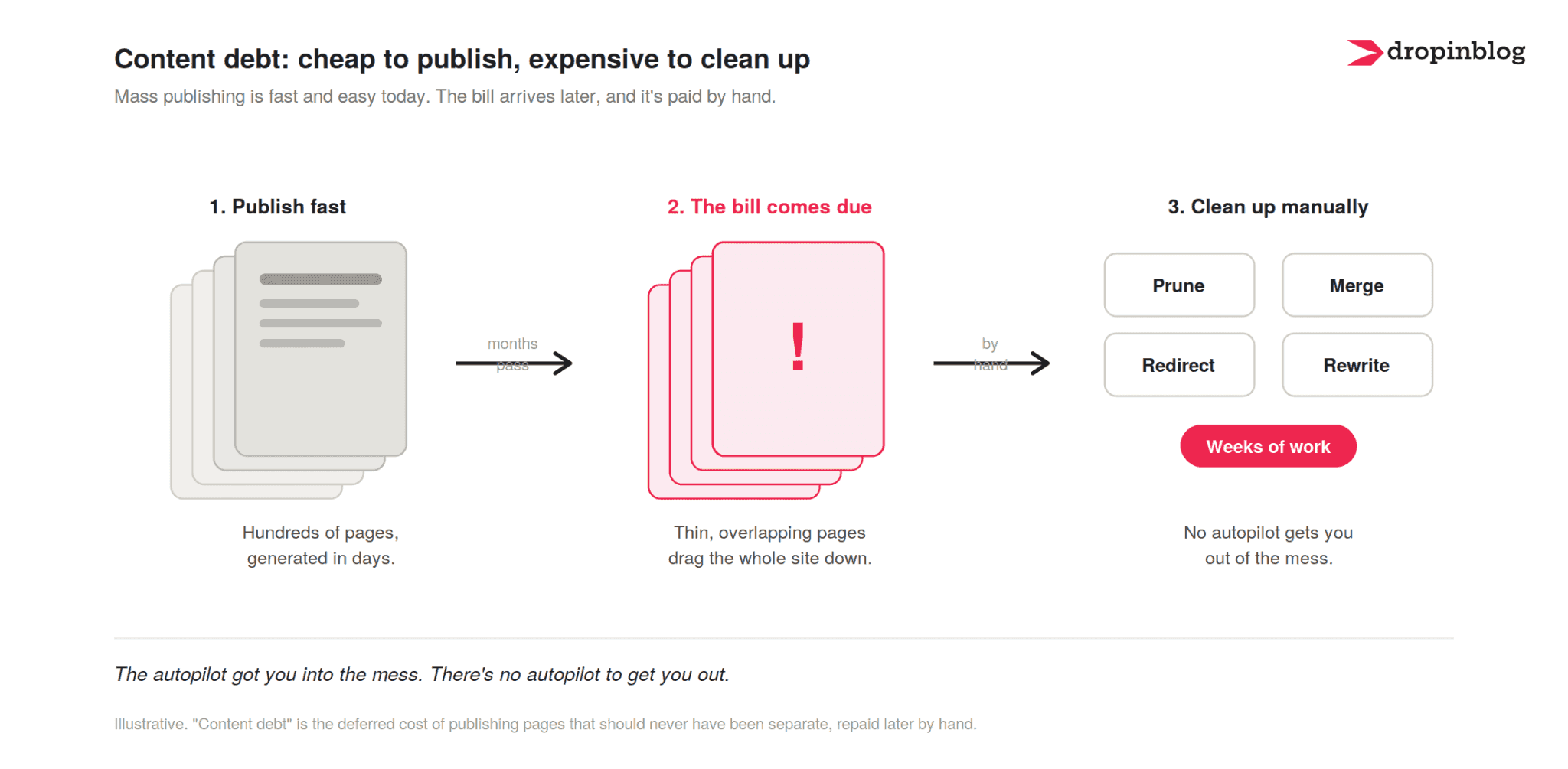
Someone (probably you) eventually has to go in and prune, merge, redirect, and rewrite all of it by hand. The autopilot got you into the mess, but there's no autopilot to get you out. Remember the showcase site that had to permanently delete its own best-performing articles – that's content debt being paid off the hard way.
This is also why "more pages" is not the same as authority. Topical authority comes from coherent coverage of a subject, a logical, connected body of work that builds on itself and answers real questions. A pile of randomly-generated articles doesn't accumulate into authority; it dilutes the focus you already had. You can't paginate your way to expertise.
And it's why one-click tools miss search intent so reliably. "Best running shoes," "how to clean running shoes," "running shoes vs trail shoes," "running shoes near me" – these all look similar but demand completely different pages. A tool optimizing for volume flattens all of that into one generic shape, so it technically targets the keyword while completely missing what the searcher actually wanted.
The ground is also shifting under the whole model
Even setting aside everything above, the one-click play is betting on a game that's disappearing. These tools live on informational long-tail queries, the "how to," "what is," and "best way to" searches. That's exactly the territory Google's AI Overviews are eating.
Pew Research, tracking real browsing behavior across nearly 69,000 searches, found that when an AI summary appears, people click a traditional result just 8% of the time, versus 15% when there's no summary, and they click the links inside the summary only 1% of the time. Ahrefs puts the click-through hit at roughly 58% lower for the top result when an Overview is present.
I don't want to oversell the doom, as I think the apocalypse talk is overdone. Other analyses suggest overall organic traffic is down by low single digits, and Google maintains that total clicks to the web are roughly stable.
The sky isn't falling. But the specific thing one-click tools are good at, which is flooding the long tail with informational pages, is exactly the thing that now gets answered inside an AI summary so the user never clicks through. The model isn't just risky, its core business case is being deleted in real time.
Where AI genuinely earns its place
None of this is an argument against AI. I use it every day, and the data backs that up; AI-assisted content ranks just fine. I used AI to help me write this article after all. The distinction is what you point it at.
AI is excellent at the thinking-support work: finding gaps in your existing coverage, summarizing a stack of source material, drafting an outline, rewriting a section that isn't landing, generating title options, comparing angles, and turning a pile of keyword data into an actual plan. Google itself endorses exactly this: using AI to research and structure content, as long as real value gets added for the reader.
The failure comes when AI stops assisting a decision and starts replacing it. That's the line between two very different things:
AI content generation asks, "write me a post."
AI content strategy asks, "what should exist on this site, why, and how does it fit together?"
The first is what the slop tools sell. The second is the part that actually compounds, and it's where I think the real opportunity is, which is why we built Blog Pilot™ the way we did, not as another AI writer racing to the bottom on volume, but as the strategy layer: topic discovery, grouping keywords by real search intent, uncovering the genuine opportunities in your niche, and building topical authority on purpose instead of publishing blindly.
The writing still requires judgment, expertise, and information worth sharing, because that's the part Google is actually rewarding.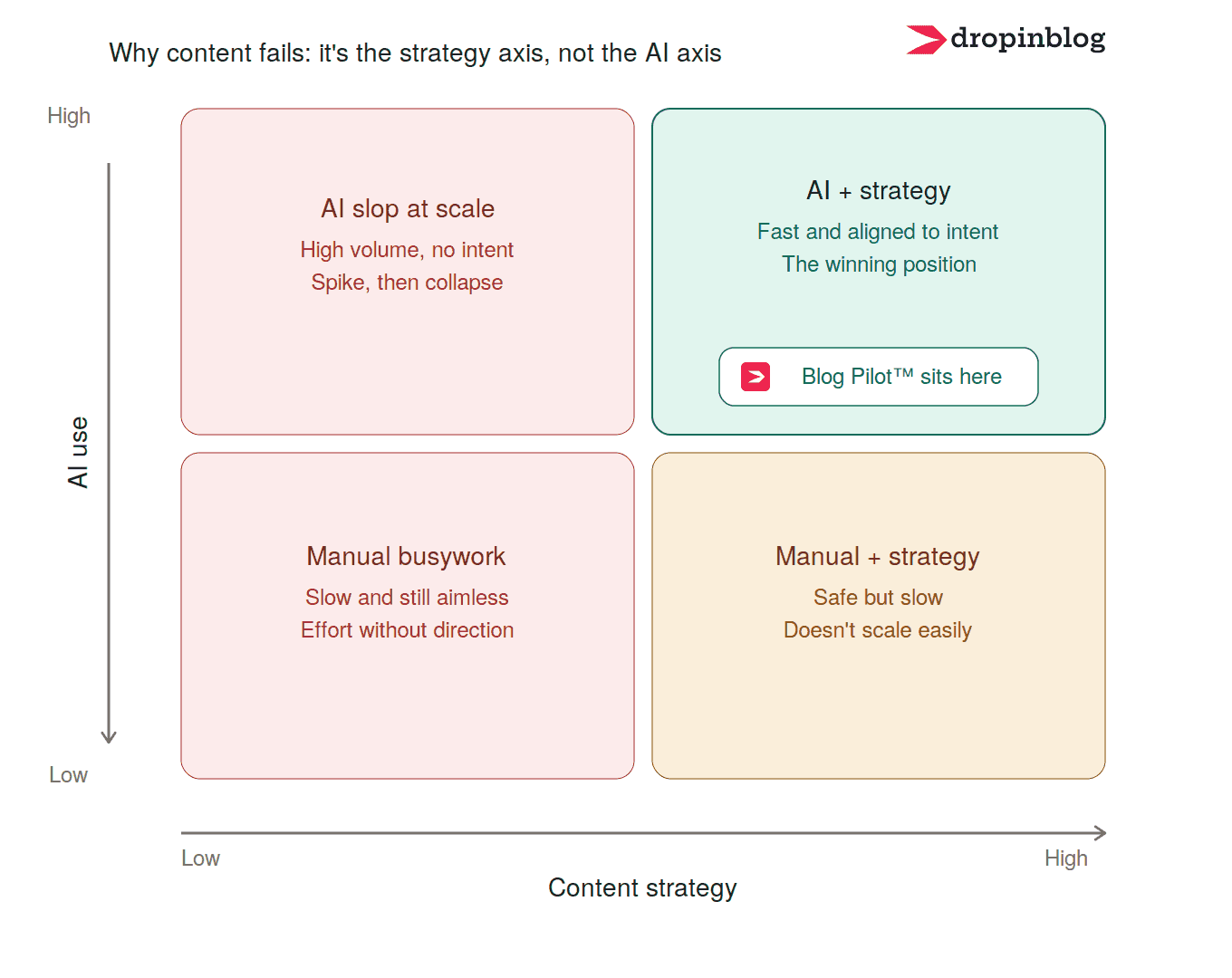
How to vet one of these tools before you buy
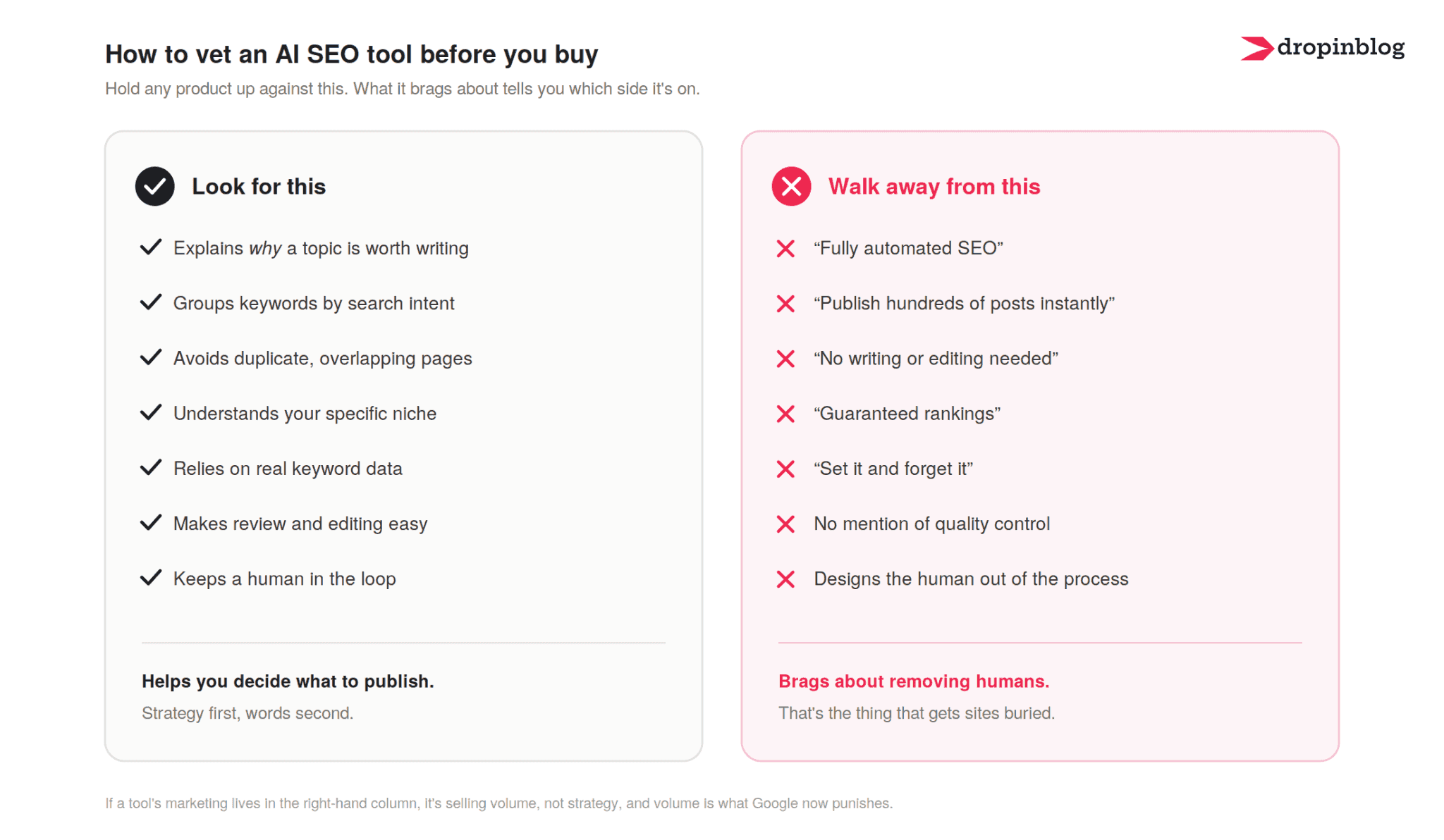
If you're evaluating an AI SEO tool, here are the questions that actually matter:
Does it explain why a topic is worth writing about, or just generate text?
Does it group keywords by search intent?
Does it avoid spinning up duplicate, overlapping pages?
Does it understand your niche, or is it generic?
Does it rely on real keyword data?
Does it make review and editing easy?
Does it keep a human in the loop, or design them out?
And the red flags, which are usually right there in the marketing copy:
"fully automated SEO"
"Publish hundreds of posts instantly."
"No writing or editing needed."
“Guaranteed rankings."
"Set it and forget it."
The bottom line
That customer who came to us didn't need more content. They needed the right content, with fewer pages, each one earning its place, built around what their actual audience was trying to find. That's slower than flipping on an autopilot. It's also the only version still standing in 12 months.
There is no instant content shortcut; there never was. AI is a genuine accelerator, making good content decisions faster, cheaper, and easier to execute at scale. What it can't do is make the decisions for you. AI SEO tools aren't a shortcut; they're a spike, a cliff, and a cleanup bill.
Publishing more content is easy. Publishing the right content, consistently, is the hard part. And it's the only part that ever pays off.
If you'd rather build the strategy than fight the slop, that's what we do at DropInBlog. Blog Pilot™ helps you decide what's worth writing before you write it, and DropInBlog drops it straight into your existing site.
Sources
Google Search Central on what you should know about the March 2024 core update and spam policies: https://developers.google.com/search/blog/2024/03/core-update-spam-policies
Google Search Central on creating helpful, reliable, people-first content: https://developers.google.com/search/docs/fundamentals/creating-helpful-content
Google Search Central on using AI-generated content: https://developers.google.com/search/docs/fundamentals/using-gen-ai-content
SE Ranking/Search Engine Land on how AI-generated content performs in Google Search: https://searchengineland.com/ai-generated-content-google-search-experiment-472234
Lily Ray (Amsive): It works until it doesn't, AI content strategies that backfire: https://lilyraynyc.substack.com/p/it-works-until-it-doesnt-ai-content-risks
Ahrefs on how AI-generated content does not hurt your Google rankings. https://ahrefs.com/blog/ai-generated-content-does-not-hurt-your-google-rankings/
Search Engine Journal on Google's March 2024 core update impact: https://www.searchenginejournal.com/googles-march-2024-core-update-impact-hundreds-of-websites-deindexed/510981/
Tech Startups on how Google deindexed 2% of sites in its March update: https://techstartups.com/2024/03/18/google-deindexed-2-of-sites-in-its-march-update-as-it-cracks-down-on-ai-generated-content-originality-ai-studies-find/
Passionfruit on building programmatic SEO without traffic loss: https://www.getpassionfruit.com/blog/programmatic-seo-traffic-cliff-guide
Pew Research Center on how Google users are less likely to click on links when an AI summary appears: https://www.pewresearch.org/short-reads/2025/07/22/google-users-are-less-likely-to-click-on-links-when-an-ai-summary-appears-in-the-results/
Ahrefs on how AI Overviews reduce clicks: https://ahrefs.com/blog/ai-overviews-reduce-clicks-update/
Marketing4eCommerce on how AI is not causing a significant SEO cataclysm: https://marketing4ecommerce.net/en/study-impact-ai-seo/