
Table of Contents
- Welcome to the New SERP
- TL;DR
- What Changed in AI Search?
- AI Visibility Metrics Explained
- How AI Systems Choose Their Sources
- AI Tools Compared
- Technical Eligibility for AI Mentions
- Overview of AI Bots
- What Makes Content "AI-Citable"? Best Practices
- Numbers Behind AI-Cited Content
- From Keyword Research to Prompt Research
- Measuring AI Visibility
- Real Examples + DropInBlog Challenge
- Prepare Your Content for AI-Based Searches
Welcome to the New SERP
As of May 2025, AI Overviews (AIOs) are officially available in nearly every country, and today, as high as 48% of Google searches include them. However, regardless of whether AIOs appear in search results or not, the search experience has drastically changed. Users often don’t click on links, so search engine visibility is no longer about securing a spot in Google’s top 10 results – it’s about being cited, mentioned, and used as a source in AIOs and LLMs.
None of this is to say that SEO is dead. It’s very much alive, but today, it has an added layer – AI. Google has confirmed that its AI features are rooted in traditional SEO, so if you want your site to appear in AIOs and LLMs, you need to ensure it is optimized for searches the old way.
In this guide, we’ll give you actionable tips and advice on how to become visible in AI-powered searches in 2026. The knowledge you’ll gain comes from no one other than Google and other AI platforms that control the search.
TL;DR
AI visibility translates to getting AI platforms to mention you, use your content as a source of information, and link to it in their answers.
The basis of answer engine optimization (AEO) or generative engine optimization (GEO) is traditional SEO. That means SEO is still alive and very much important.
You use different AI-focused strategies to optimize search experiences. As Google points out, optimizing search experiences is what you do with traditional SEO, too, so AI SEO is still SEO.
You can help AI extract your content by structuring it with lists, tables, and headings, and making it clear by using consistent terminology and an answer-first strategy in your writing.
To improve your chances of appearing in AI-based search results, your content should have strong topical coverage and stay fresh by consistently providing up-to-date information.
Referring domains, Reddit/YouTube presence, and other off-page signals also play a large role in getting cited by AI tools.
For now, only Bing Webmasters Tools offers first-party AI citation data. To get more insights into your content's AI visibility, you’ll need a third-party app designed for this specific purpose.
What Changed in AI Search?
In the past year, Google Search started offering two AI experiences – AI Mode and AI Overviews. Together, Google’s AI Mode and AIOs have reduced organic click-through rates (CTRs) and changed the significance of ranking on the first page of Google.
Unless you went through the trouble of hiding AIOs using workarounds, you’ve seen them in search results. They appear above the traditional top 10 results, consolidating information from various sources in a single place. Now, you’ll often have no reason to visit the website, especially if your query is a simple how-to question. Even with more complex queries, users aren’t all that motivated to click on the link in AI answers.
The AI Mode works a bit differently, but still affects click-through rates. It has a dedicated interface, but unlike AIOs, it doesn’t show blue links. Instead, it opens a separate window that offers a conversation-based research experience powered by Gemini. It’s also different from AIOs in how it processes the information. It uses a query fan-out system that breaks a search query into several subqueries to provide more detailed answers.
Today, Google’s AI Mode alone has over 1 billion monthly users, while AIOs appear in about 48% of all searches. The two AI experiences are setting new rules for how users interact with Google Search.
The results of the two new AI experiences that now dominate Google Search are reduced CTRs and zero-click searches. However, the traffic that comes from AI is nearly 5 times more likely to convert than the traffic from traditional search. So, getting mentioned and cited by AI is a new way to attract the right audience to your site.
One interesting thing is that you no longer have to be in Google’s top 10 results to gain search visibility. Ahrefs reports that 38% of sites that are cited by AIOs rank in Google’s top 10 results. What’s even more interesting is that this figure has dropped significantly since July 2025, when 76% of AIO-cited sites ranked in the top 10. For AI Mode, the share of sites that get cited and ranked on the first page of Google is even lower, at 12%.
So, the tricky part isn’t just adapting to the new search experience, but optimizing your content for both AI Mode and AIOs. The two rarely cite the same sources, with 13.7% citation overlap.
The strategic shift: moving from a rank-driven approach, where the top 10 results accounted for nearly 97% of all clicks, to becoming a reliable source of information that AI cites.AI Visibility Metrics Explained
Unlike the traditional rankings, AI visibility goes beyond clicks. Your content can show up in AI Overviews, for example, but not result in a click. That’s why AI visibility is measured across four metrics: citations, mentions, traffic, and grounding queries.
Citations: These are the site links you see in chat-based AI tools such as ChatGPT, Perplexity, and Gemini. When an AI tool cites your site as a source, users can click through to verify the answer and explore the topic further. AI citations are the most obvious form of AI visibility, as they create a visible connection between the answer and your site.
Mentions: Mentions happen when an AI tool names your brand, product, or content without linking to it. These often come from learned association or information the model treats as general knowledge. Although mentions don’t drive clicks, they build awareness, familiarity, and brand equity, which makes them just as important as AI citations.
Traffic: These are actual visits your site gets. Traffic is a measurable metric that tracks the visits that happen when a user clicks on a link in an AI answer and lands on your site. This metric alone isn’t enough to give you a complete picture of your AI visibility, and it should be observed in combination with AI mentions and citations.
Grounding queries: These queries are a relatively new concept in which AI uses a source-checking layer to assess the accuracy of retrieved information and provide an answer from a reliable source. It may use your content even if it later doesn’t cite or display it in an answer. Still, you can use these queries to discover how AI systems use your content.
You can use these four metrics to better understand how your content performs in AI searches. To start improving your AI visibility, you have to rank in traditional search results first, as this is where AI-powered tools like AIOs, ChatGPT, and Claude get their information. Despite what many people on the internet say, AI SEO isn’t a special SEO discipline, but an extension of the classic search.
Additionally, users now trust and use AI-based search tools more often than they did a year ago. With citations and grounding queries, the chances of discussing your optimal daily intake of rocks with AI are very low.
Let’s look at some examples of AI-powered searches.
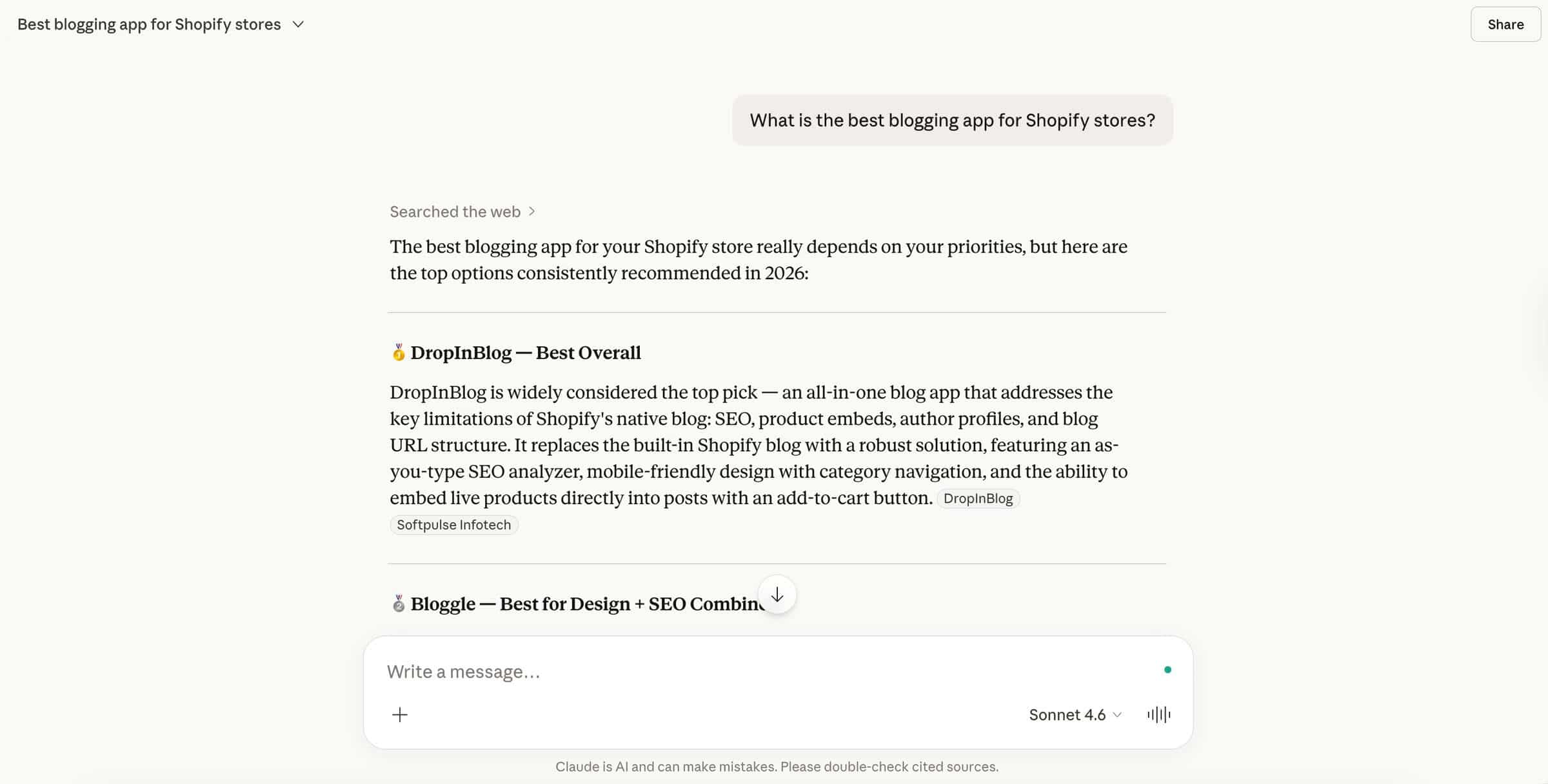
We asked Perplexity to help us find the best blogging app for Shopify stores, and it gave us a list of its top contenders.
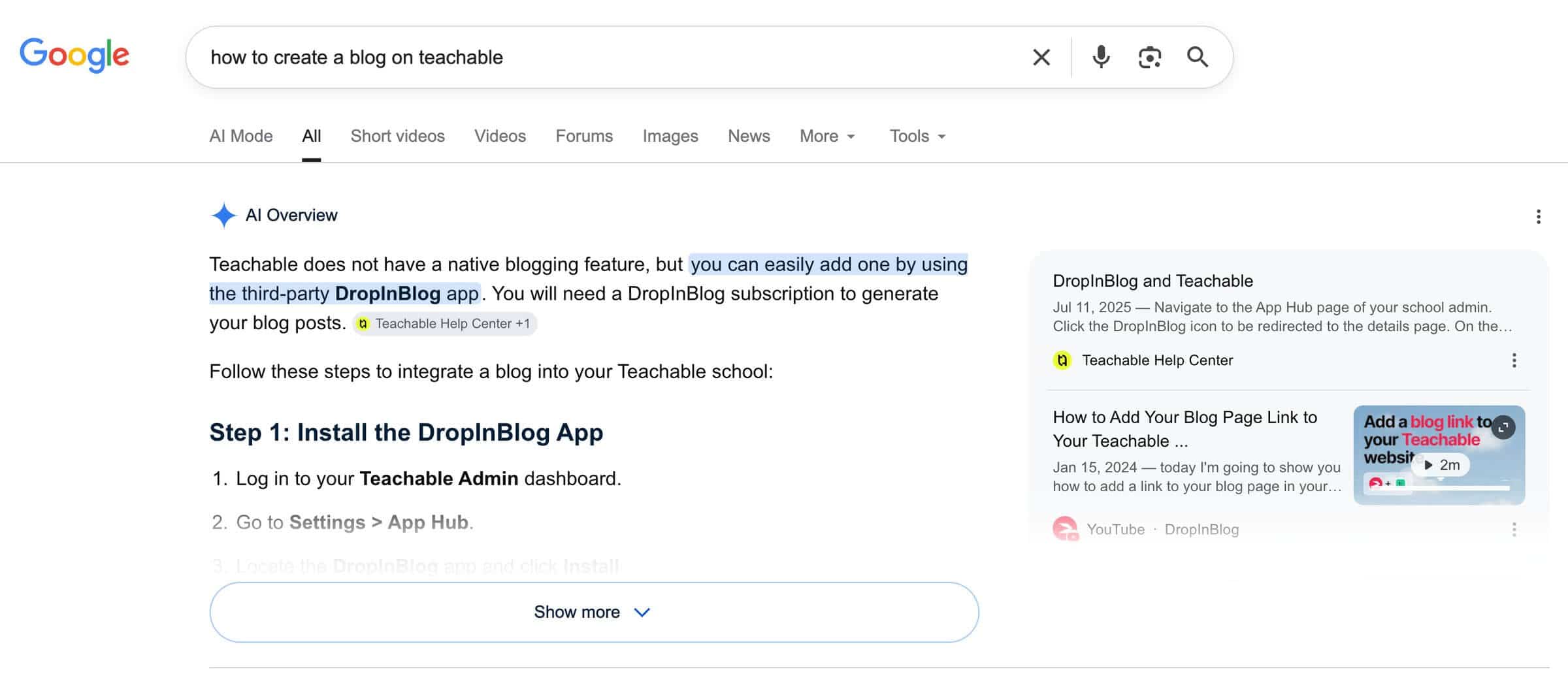
Then, we asked Google how to create a blog on Teachable and got the information in the AI Overview section.
Lastly, we tested ChatGPT to learn more about its recommendations for the best SEO blogging app, and we received a list of a few candidates drawn from 50 sources.
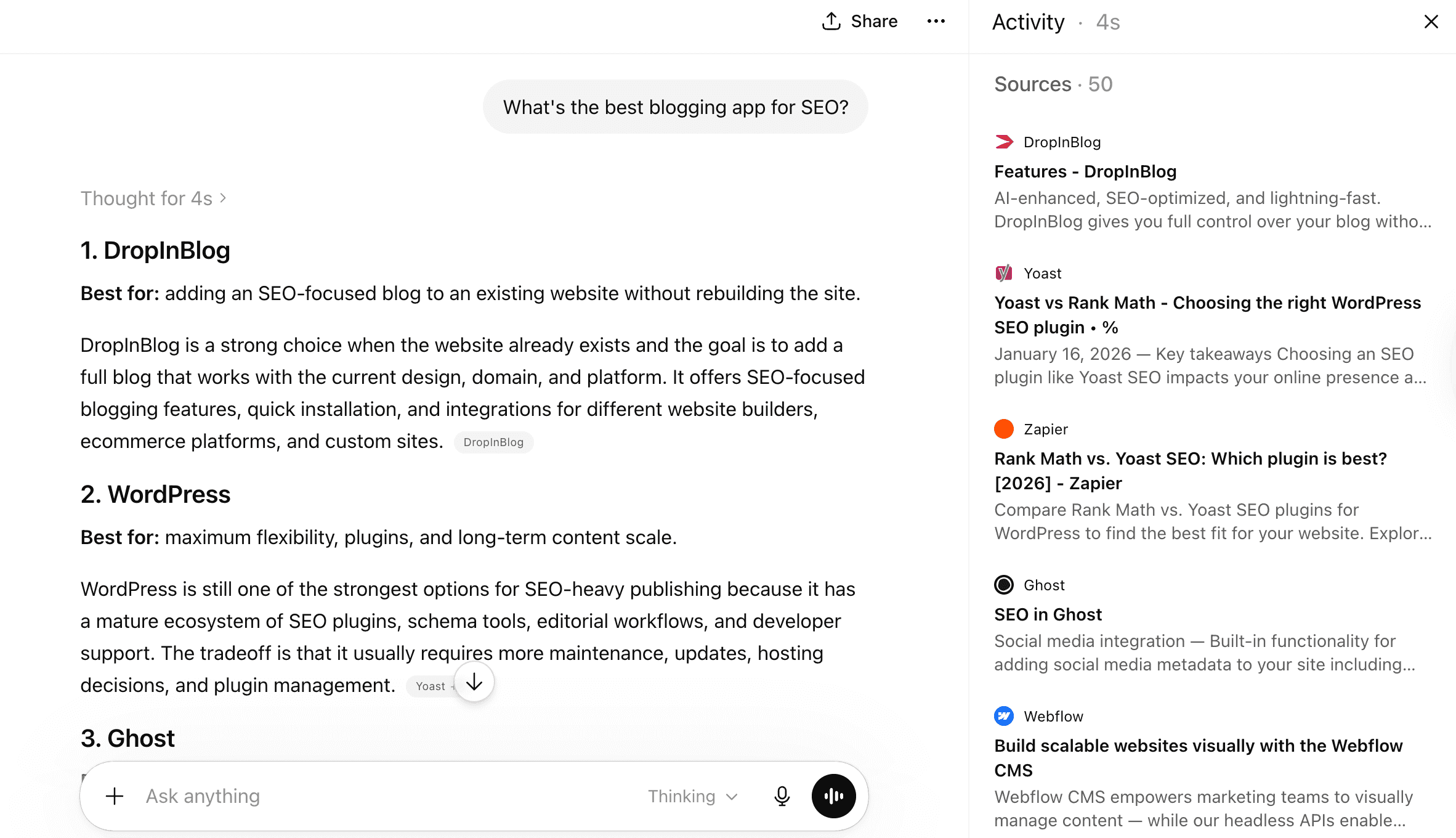
If you look at the screenshots, you’ll see DropInBlog showed up in all these AI answers. Some of these are citations, some are mentions, but it gets a fair amount of attention from AI search tools. Later in this article, you’ll learn how DropInBlog does that and how you can do the same for your site, too, using the framework called AI CITED.
How AI Systems Choose Their Sources
AI systems process information using four approaches: retrieval augmented generation (RAG), query fan-out, trained knowledge, and a hybrid approach.
Retrieval Augmented Generation (RAG)
RAG is a technique that AI systems use to retrieve relevant information from external resources rather than relying only on the data they were trained on.
Behind the scenes, the data is first structured in a way that AI systems can use. That data is divided into smaller parts that can be retrieved independently when a user enters their search query.
This method works great for retrieving fresh, accurate data that can be traced back to its source.
Query Fan-Out
Another technique AI systems use is called query fan-out, which breaks a user’s query into multiple subqueries. An AI system approaches the query from several angles, and in this way, it can provide a more complete answer.
So, if you ask Google’s AI Mode about the best blogging app for SEO, it may look into the best blogging apps for SEO, blogging platforms with schema and metadata control, e-commerce blogging apps, and blogging apps for small businesses.
The query fan-out technique changes how users discover content, as it doesn’t look for an exact query match but instead broadens the search.
Trained Knowledge
Trained knowledge is based on feeding the AI with specific information. The AI then learns about the relationships between words and concepts, and when a user enters their query, it generates answers instantly.
AI systems using this approach already “know” things, so they rarely cite their sources. The downside is that all of them have a cutoff date, or the date when the model was last updated. So, they can’t retrieve information about events that occurred after that date.
This method works great for reasoning, summarizing complex concepts, and generating consistent information.
Hybrid Approach: Retrieval, Query Fan-Out, and Trained Knowledge
Most AI search tools we use today use a hybrid approach, combining RAG, query fan-out, and trained knowledge. This combination allows AI systems to retrieve fresh sources and, at the same time, rely on what they already know. All of these AI tools look for the same signals to determine what content to cite, including:
Clear structure: This practice involves the proper use of a heading hierarchy and a logical content flow, which helps AI better understand the content.
Trustworthy formatting: This refers to the consistent use of headings, spacing, bolded phrases, and alignment. It also refers to maintaining a clean look of your content using short paragraphs and sentences, inserting numbered and bulleted lists, CTAs, helpful visuals, and links.
Cited sources: This practice refers to adding your resources and citing them using the appropriate citation style.
AI Tools Compared
When you type the same query into Google, ChatGPT, and Perplexity, you’ll get different citations and mentions, depending on how these platforms process and use your content.
Google’s AI Overviews: AIOs use RAG, but they may also use query fan-out. Google retrieves relevant sources from its Search index, and then Gemini generates an answer based on these sources. The answers you get come with citations and clickable links.
Google’s AI Mode: AI Mode also uses RAG but places a stronger focus on the query fan-out technique. It examines a query from multiple angles, then pulls sources from Google’s Search index, and provides a conversational answer. Like AIOs, AI Mode offers citations with clickable links. If your site ranks on Google, it has a good chance of being cited because, interestingly, Google.com is the most-cited domain in AI Mode.
ChatGPT Search: This AI system uses RAG and query fan-out, but unlike Google’s AI experiences, it retrieves relevant sources from third-party search providers, OpenAI’s search crawling ecosystem, and partner content. The ChatGPT model generates an answer and selects the sources it will cite. An AirOps study found that ChatGPT cites only about 15% of its sources. Even with these low numbers, ChatGPT has 900 million weekly active users, and it’s a major AI discovery platform.
Perplexity: Perplexity uses real-time RAG. It searches the live web in query time and uses its own search index and external search sources to generate a cited source. This AI system is known for offering fresh content and high citation rates, with an answer from Perplexity typically displaying 5 to 12 sources.
Gemini (consumer app): Gemini uses a form of RAG. It retrieves relevant sources from Google Search, then generates an answer based on the retrieved data. Since its retrieval layer is Google Search, you have a good chance of earning citations from Gemini if your content is indexed and ranks well on Google. However, Gemini doesn’t always cite its sources, so there’s no guarantee your content will get a link.
Claude (web search): When web search is turned on, Claude uses real-time RAG. Like Perplexity, it uses third-party search providers to gather the information from the live web and forms its responses based on this data. The answers contain citations to the sources that Claude used to generate its output.
The citation logic differs from one AI system to another. ChatGPT and Perplexity mostly don’t cite the same domains, with only 11% of domains cited by both platforms. ChatGPT is also less likely to cite brands than Perplexity, at 0.59% and 13.05% respectively.
These numbers show that you shouldn’t just optimize your content for AI searches generally, but also have a separate strategy for each platform where you want to gain visibility.
The one thing all of these AI search tools have in common is blogs. Blogs and content sites are the fifth-most-cited resource after Reddit, Wikipedia, news sites, and government sites.
Do you have a blog? If not, you can start blogging with DropInBlog today.
Technical Eligibility for AI Mentions
Before you start working on your AI visibility strategy, make sure your content meets the technical criteria for being mentioned and cited by AI tools. These criteria include:
Crawlability
AI and search tools need permission to visit a page. Check whether your robots.txt file contains rules that restrict access to bots. A common wildcard rule that blocks all bots and prevents them from seeing your site is User-agent: * Disallow: /. Make sure your robots.txt file doesn’t include it.
Indexability
Just because a bot can access your page, it doesn’t mean that AI tools will use it as a source, mention, or cite it. Your page also needs to be eligible to appear in search results. To ensure that your page is being indexed, check that your page HTML or HTTP header doesn’t include noindex tags.
In your CMS, you’ll find options that exclude a page from indexing in its SEO or advanced settings (e.g., “don’t show in search results,” or “noindex this page”). Make sure these settings aren’t turned off for your content.
Accessibility via Text
Another important part of making your content eligible for AI mentions and citations is in how your content is served to bots. AI bots can access it if it’s available in text format, but if it appears only after JavaScript runs, they may not see it.
While lazy-loading is good for images and improving site speed, the page text should at least be available in the initial HTML with pre-rendering or server-side rendering. Avoid making your content available only after a user accepts cookies or logs in.
If your blog runs on DropInBlog, posts installed through a platform app, an SDK, or the API arrive as server-rendered HTML, and the quick HTML embed can serve static HTML with the SEO Supercharger. Here’s how DropInBlog posts get indexed.
Internal Linking
Although interlinking your site’s pages isn’t a technical requirement for AI visibility, you should add internal links to your content to help AI bots easily find and better understand your content.
One way to improve internal linking on your site is to create topic clusters, which will help AI bots better understand relationships between pages. It’s also a good practice to use descriptive anchor text and have at least one page link that connects two pages on your site.
Page Speed
There’s no proof that AI bots pick up fast-loading pages more often, but a study from SE Ranking showed that pages with an FCP under 0.4 seconds had an average of 6.7 citations in ChatGPT, while slower pages with an FCP over 1.13 averaged 2.1 citations. Even though this is just a correlation, it doesn’t hurt to optimize your site for speed, since that’s one of the ranking factors in traditional search. After all, you want to create a good user experience for your visitors, and a page that loads quickly does exactly that.
Overview of AI Bots
Below is a table of the known bots from notable AI companies, along with an explanation of what each does.
| OpenAI | Anthropic | Perplexity | Microsoft | |
|---|---|---|---|---|
| Googlebot: controls Google Search, AI Overviews, and AI Mode | GPTBot: used for training | ClaudeBot: used for training | PerplexityBot: used for discovering and indexing content | Bingbot: controls Bing search and Copilot citation eligibility |
| Google-Extended: used for training and grounding Gemini Apps, Gemini API, Vertrex | OAI-SearchBot: used for ChatGPT search indexing and citation eligibility | Claude-SearchBot: used for Claude search indexing and citation eligibility | Perplexity-User: Used when a user asks Perplexity to open a specific page | |
| ChatGPT-User: Used when a user asks ChatGPT to open a specific page | Claude-User: Used when a user asks Claude to open a specific page | + Undeclared crawlers |
If you want these AI tools to cite and mention you, you should grant access to your site’s content to these AI bots:
Googlebot
OAI-SearchBot, ChatGPT-User
Claude-SearchBot, Claude-User
PerplexityBot, Perplexity-User
Bingbot
If you don’t want AI to use your content for training, disallow access to your site to bots like GPTBot and ClaudeBot.
What Makes Content "AI-Citable"? Best Practices
We’ve come to the actionable part of our AI optimization guide: what you can do to make your content more visible in AI searches. The answer is simple: just follow our AI CITED framework.
A – Answer-first structure
I – Intent-matched headings
C – Clusters and topical depth
I – Information freshness
T – Trusted authority
E – Expert POV
D – Direct structure
Answer-First Structure
When creating a new blog post, you should offer a brief answer in the first paragraph, preferably in the first 40-60 words. A Growth Memo study showed that 44.2% of all AI citations come from the first 30% of your text. That’s a good enough reason to avoid long intros.
For example, if you’re writing about the best blogging apps, you could open with a couple of sentences like:
“The best blogging apps are DropInBlog, WordPress, and Squarespace. To learn about the pros and cons of each, read on.”
Additionally, this answer-first structure gives your readers a reason to come back to your blog. They’re rewarded (with an answer) from the start, and don’t have to look for the answer. They already did their search on Google. They don’t need to do another one on your site, which is why you should get to your point early in the content.
With short-form content, it’s easy to provide concise information. However, with longer content, you have more concepts to explain, or you explain them in more detail. That’s why you need a way to highlight the key talking points of your content. Including summaries at the top of your content is one way to do so.
The most common ones are TL;DR and Key Takeaways. They provide an overview of what’s discussed in the content. AI tools usually jump to this section first, then proceed to analyze the content and find relationships between headings.
Intent-Matched Headings
Headings are an excellent organizational tool, allowing you to break your content into smaller chunks. AI also loves headings and uses them to add links to the answers found on your site.
When you click on a result in Google’s AI Overview, you’ll notice that AI highlights parts of the cited text. We asked Google how to add a blog to an HTML site, and the AI Overview cited DropInBlog under the "Choose a blogging platform” section. If you look at the screenshot below, you’ll see that AI highlighted one of the article headings, relevant to our search query.
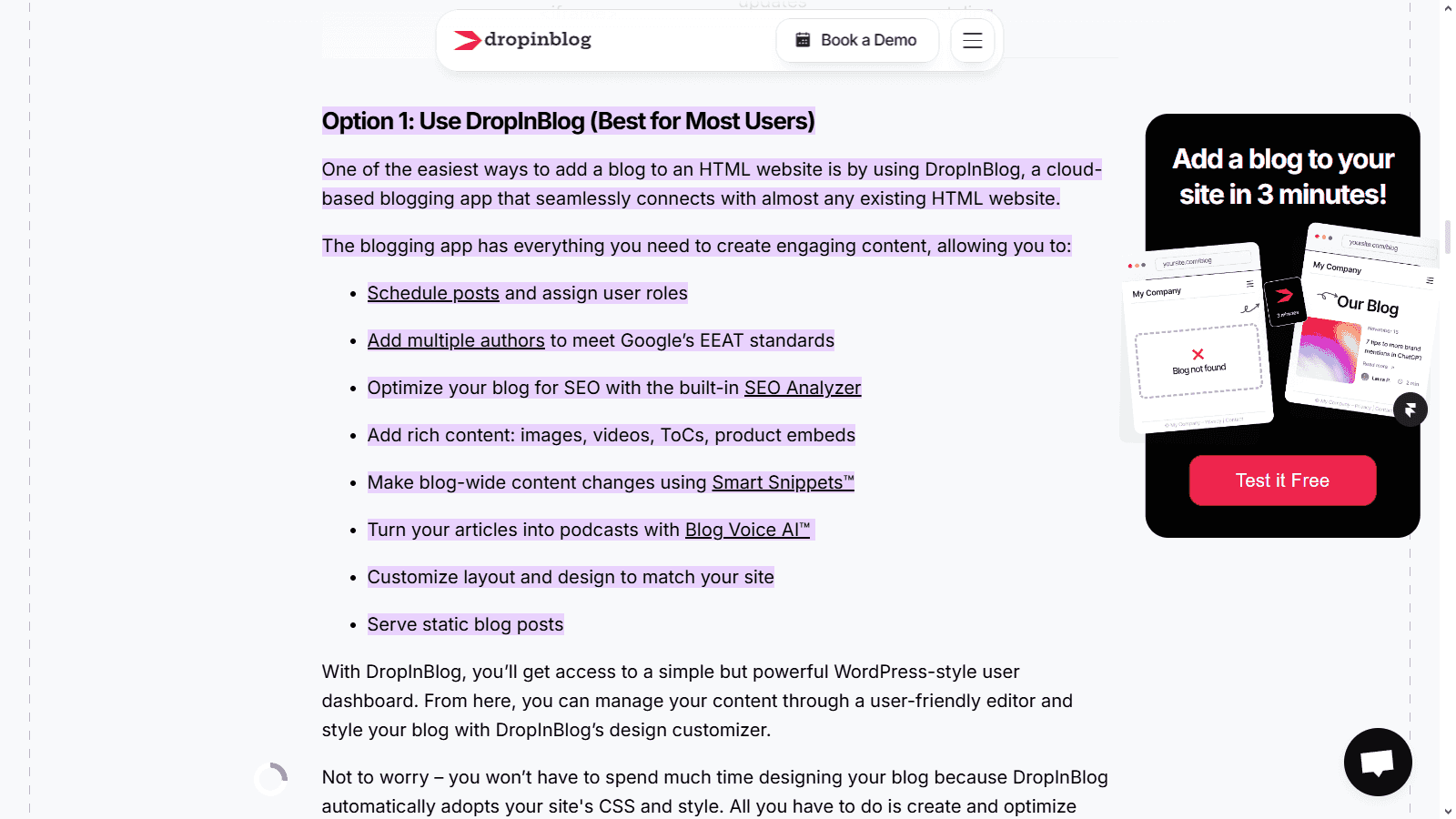
Another thing to consider is follow-up intent. Your headings shouldn’t just include your keywords, but they should also include follow-up questions a user might ask next.
Remember the query fan-out technique and how some AI tools don’t always look for the exact query but divide it into multiple subqueries? Using this method, AI tools will often think about the user’s follow-up questions to provide a more complete answer. By including these questions in your headings and offering a direct answer in the first one or two sentences, you’re adding depth to your content and, at the same time, giving AI tools more reasons to cite it.
So, if you want your content to appear in AI searches, you should:
Add heading levels 2 and 3 to your content.
Try to incorporate your primary keywords into your headings.
Add related questions to your headings to cover follow-up intent.
Clusters and Topical Depth
AI systems may be more likely to cite content from sites that cover a topic in depth. One standalone article can answer a specific question, but it usually isn’t enough to show broader expertise or authority in your niche. That’s where topic clusters help.
With topic clusters, you group related articles around one core theme. For example, if you’re writing about AI mentions, you could create supporting posts about ChatGPT citations, Google AI Overviews, tracking AI visibility, and robots.txt rules for AI crawlers.
These connected articles help build broader topical coverage. And when you link them together, search engines and AI systems can more easily understand the relationships between your content and recognize your site as a more complete resource on the subject.
Information Freshness
If you want AI tools to treat your content as a useful source, you need to keep it up to date. Unlike traditional search, which usually returns a ranked list of results, AI tools often generate answers in real time when a user types a query. For fast-changing topics like SEO, AI, statistics, and pricing, they need sources that are current and accurate. So, if two pages explain a topic equally well, the more up-to-date one may have a better chance of being cited.
Research also suggests that AI tools tend to cite fresher content. An Ahrefs analysis reveals that the average age of URLs cited by AI assistants is 1,064 days, compared with 1,432 days for URLs in traditional organic search results. That means AI-cited URLs are, on average, about 25.7% fresher.
To keep your content fresh, review facts, stats, screenshots, product details, and recommendations at least quarterly, especially on pages about fast-changing topics. It’s also helpful to add a “Date Modified” or “Last Updated” label so users and search systems can see that the content has been updated.
Trusted Authority
AI tools are known for hallucinations, but inaccurate information isn’t only an AI problem. The internet is full of outdated stats, unsupported claims, and misleading advice, so proof matters.
If you want your content to be treated as a reliable source, you need to link to original studies, official documentation, industry reports, and expert sources so readers can verify the source of the information. AI search tools look for similar trust signals before citing a page.
But authority isn’t only about linking out to credible sources. It’s also about whether others trust and reference your brand. AI tools won’t only look at the things you say about yourself. Third-party mentions, referring domains, other sites citing your work, brand reputation, and original research that earns links can all strengthen your authority.
A reader is more likely to trust AI optimization advice from a platform that built its own AI optimization tool than from a random website with no visible experience in the space. AI systems may use similar signals to understand which sources are credible enough to mention or cite.
Expert POV
The recipe for getting AI mentions isn’t secret. Anyone can find the best practices for optimizing their content for AI tools. That’s not enough, though. Much like with regular searches, your content needs to be distinguishable. AI tools don’t just need another rewritten version of what already exists online. They need content that adds something new, useful, and credible. To meet this criterion, consider the following best practices:
Discover how others covered a topic, and find an angle that no one talks about.
Use real-life examples in your content instead of generic ones.
Add original data, statistics, and findings from your own research.
Add your understanding of the trends, studies, and guidelines.
Include opinions from experts in your niche.
Share insights from customer conversations, experience with a product, or real industry use cases.
Create visuals that users can’t find on competitor sites.
Create your own study.
Expert POV is the part only you can write. For example, anyone can explain what AI mentions and citations are, but not everyone can share data from their own AI optimization platform, screenshots from their workflows, and lessons they learned while helping their customers optimize their content for AI searches.
Apart from text, AI also recognizes videos, images, and other types of non-textual content. To make those assets easier to understand, follow these best practices:
Add alt text to your images. When possible, include relevant keywords.
Ensure your videos have transcripts.
Create descriptive captions for diagrams, charts, and screenshots.
AI-friendly content often coincides with user-friendly content. So, much like with traditional searches, if you want to be visible in AI searches, you need to write for people first. What is different is how AI tools retrieve, summarize, and cite information from their sources. The more original, specific, and experience-based your content is, the more valuable it is to AI tools and users alike.
Direct Structure
AI tools are more likely to understand, summarize, and cite content that is easy to parse. That means your page should be clear both visually and technically. To accomplish that, use descriptive headings, clean HTML, concise sections, lists, tables, and relevant schema where appropriate.
Schema can support this structure, but it isn’t a shortcut to AI citations. Google has explicitly said there’s no special markup that makes content eligible for AI visibility. So, if you’re using schema, use it to label your content type for search engines and optimize your content for traditional SEO features, such as rich results. Think of it as technical scaffolding: helpful for reinforcing a well-structured page, but not something that automatically triggers AI mentions or citations.
Numbers Behind AI-Cited Content
By now, numerous studies point to average numbers for the content cited by AI tools, including paragraph length, referring domains, and links. Here’s what these numbers say:
Content length: A study by Higglo found that articles with over 2,900 words got an average of 5.1 citations, while those with fewer than 800 words averaged 3.2 citations. However, the takeaway here isn’t to write long content, but to cover a topic in-depth and give AI tools enough context to cite it.
Section length: Higglo also found that pages containing between 120 and 180 words between headings performed better and earned 70% more citations than pages with very short sections. The takeaway here is that while clear structure matters, overly brief sections may not provide enough context, which is why AI cites this type of content less frequently.
Statistical data points: The same study also revealed that articles that had 19+ statistical data points received more citations than those with minimal data. According to the data from the study, the average citations for these two groups were 5.4 and 2.8 respectively, suggesting that supporting your claims with concrete data can improve a page’s credibility and citation potential.
From Keyword Research to Prompt Research
Traditional SEO focuses on keywords, while AI search relies on prompts.
Instead of typing short queries like “Shopify blog app,” users now ask full, conversational questions like “What’s the best blogging app for a Shopify store?” or “Can I add a blog to Shopify without using WordPress?”
This shift in how users interact with AI tools is evident in the average length of search queries. A recent study found that the average query length in AI Mode is 7.2 words, about twice as long as a traditional 4-word search query.
Instead of relying solely on keyword research, your AI visibility strategy should also include prompt research. It will help you understand how users interact with AI tools. Here’s how to do it.
Test Your Topic in AI Search Tools
Test your topic in ChatGPT, Perplexity, and Google AI Mode to run variations of your target keyword queries. Use fresh sessions or incognito mode where possible, because chat history can taint the output.
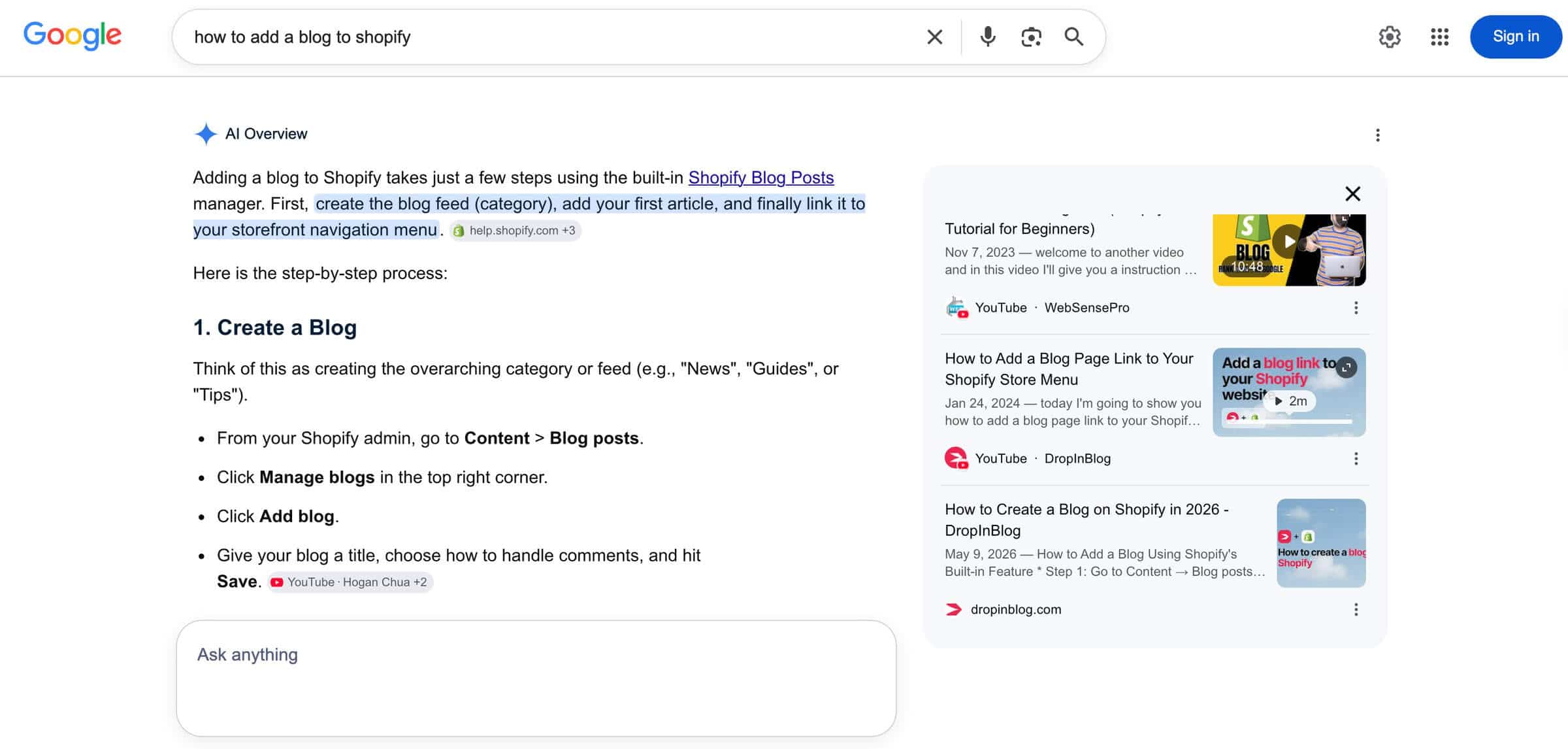
We used Google’s AI Overviews to discover how DropInBlog ranks for Shopify-related queries.
Capture the Prompts and Citation Patterns
Write down the prompts, follow-up questions, cited sources, and repeated phrasing patterns.
We discovered that AIOs ranks our Shopify blog integration guide for “how to add a blog to Shopify” and “Shopify blog integration guide.” However, when we tried a variation of this keyword (how to create a blog on Shopify), we discovered that DropInBlog isn’t on AIO’s source list.
If your site has data in Bing Webmaster Tools’ AI Performance report, review your grounding queries. These are the reformulated queries Copilot generates internally when it retrieves web content.
Organize Prompts by User Intent
Group similar prompts by intent: definition, comparison, how-to, troubleshooting, product selection, pricing, alternatives, and use case. Doing so will help you easily identify what your content should do, whether this is to educate, persuade, or guide the reader. The prompts you’ll get from framing your content this way will be more useful and better aligned with a user’s search behavior.
Turn Prompt Patterns into Headings
Integrate each important pattern into an H2 or H3 on your page.
For example, if you’re optimizing a page around Shopify blogging apps, don’t stop at the keyword “Shopify blog app.” Broaden your reach with phrases that target different angles, like “best SEO-friendly blog app for Shopify,” “professional blogging app for Shopify,” and others.
This is prompt-aligned heading optimization. You’re not stuffing keywords into headings. You’re turning real user questions, AI follow-ups, and prompt patterns into sections your content can answer directly.
The takeaway: Optimize for the full prompt journey, not just the keyword. Find the questions users ask, the follow-ups AI tools generate, and the phrasing patterns that appear across AI answers. Then turn those patterns into clear headings, concise answers, examples, and comparison sections on your page.Measuring AI Visibility
Measuring AI visibility is more difficult than measuring traditional SEO because AI tools don’t behave like static search results. The same prompt can generate different answers every time a query is repeated, so you can’t rely on a single source of data for tracking AI mentions and citations.
In 2026, the best way to measure your visibility combines several approaches: gathering first-party data from Bing Webmasters Tools, finding prompt-like queries in Google Search Console, tracking referral traffic in Google Analytics 4, using third-party share-of-voice tools, and manual checks.
Bing Webmasters Tool AI Performance Report
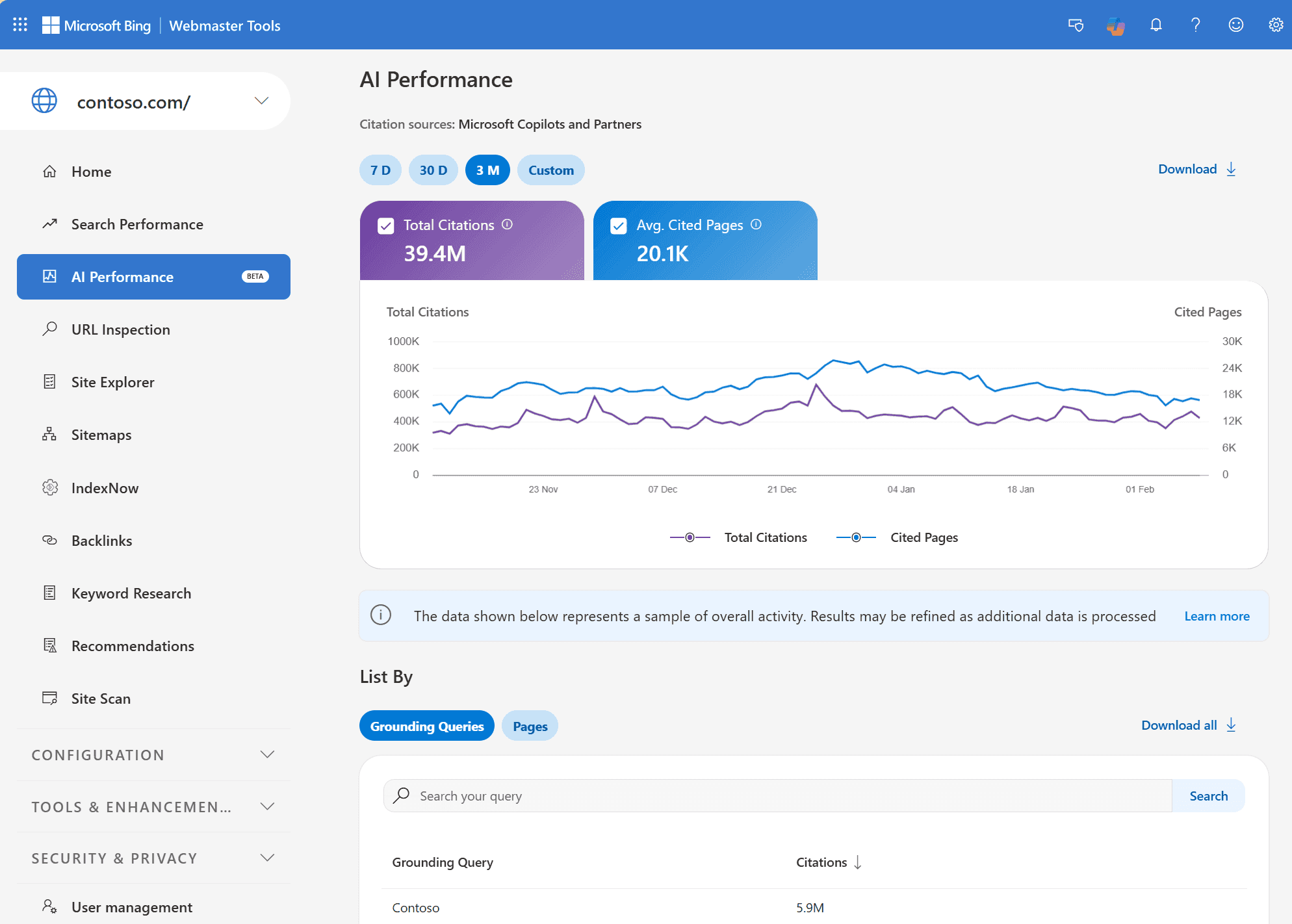
In 2026, Bing launched its first-party AI citation reports, AI Performance. It shows you how often your site appears in AI-generated answers in Microsoft Copilot, Bing’s AI summaries, and select partner integrations.
The report has helpful metrics, such as Total Citations, Average Cited Pages, and Grounding Queries. Although Google is the most used search engine, some AI tools, like ChatGPT, use Bing as their search provider. That means you can still get some valuable information about how your site performs in AI-based searches.
Google Search Console
Google Search Console (GSC) includes AI Mode and AI Overview activity, but it doesn’t offer a dedicated filter for AI visibility. That means you can’t use GSC as a direct AI citation reporting tool. Still, it can help you spot signals that may point to AI search behavior.
Create a custom (regex) filter in GSC to find long, conversational queries, especially those with seven or more words. These queries often look more like prompts than traditional keywords, so they can help you identify AI-style search behavior.
In Google Search Console, open the Performance → Search results report, click + New → Query, and switch the dropdown to Custom (regex). To surface long, prompt-style queries with seven or more words, paste this pattern:
^(\S+\s+){6,}\S+
That matches any query string containing seven or more space-separated words.
Once the filter is applied, sort by Impressions to see which prompt-style queries your site already ranks for, then check the Pages tab to see which URLs are picking them up. Pages with rising impressions but flat or declining clicks are strong candidates for AI-driven discovery.
GSC won’t tell you exactly when your brand was mentioned or cited in an AI answer, but it can help you understand which queries and pages deserve a closer look. Use it as an indirect signal, not a complete AI visibility report.
AI Referral Traffic in GA4
If you want to track AI referral traffic in Google Analytics, you can now easily do that from your GA4 account. GA4 automatically labels traffic from AI assistants, such as ChatGPT, Claude, and Gemini.
Using this data, you can see how your content performs in AI searches and whether AI tools cite it.
Third-Party Tools
When paired with Bing Webmasters Tools, GSC, and GA4, third-party AI visibility tools form a more complete picture of your presence in AI searches. The way these tools work is they test a defined set of prompts and record whether your brand appears, which competitors appear, which sources are cited, and how visibility changes over time.
When comparing tools, you should look for model coverage, update frequency, share-of-voice tracking, prompt/query analysis, competitor tracking, and pricing.
Below is a comparison table of the best AI rank tracker tools in 2026:
| AI rank tracker | Models supported | Data update frequency | Grounding/query analysis | Share-of-voice tracking | Pricing |
|---|---|---|---|---|---|
| SE Ranking AI Tracker | AI Overviews, AI Mode, Gemini, Perplexity, and ChatGPT | Daily | ✓ Yes | ✓ Yes | From $129/month |
| LLMrefs | AI Overviews, AI Mode, Copilot, ChatGPT, Perplexity, Gemini, Claude, Meta AI, and AI Grok | Weekly | ✓ Yes | ✓ Yes | From $79/month |
| Ahrefs Brand Radar | ChatGPT, Perplexity, Gemini, AI Overviews, AI Mode, and Copilot | Every few days | ✗ No | ✓ Yes | From $129/month |
| Peec AI | ChatGPT, Perplexity, Gemini, Copilot, Grok, AI Mode, and AI Overviews | Daily | ✗ No | ✓ Yes | From $95/month |
| Mangools AI Search Watcher | ChatGPT, Mistral AI, Gemini, Claude, DeepSeek, Grok, and Llama | Weekly | ✗ No | ✓ Yes | From $12/month |
| Profound | ChatGPT, Claude, Perplexity, Copilot, Gemini, Grok, DeepSeek, Meta AI, AI Mode, and AI Overviews | Daily | ✓ Yes | ✓ Yes | From $99/month |
Otterly | ChatGPT, Perplexity, Gemini, AI Overviews, AI Mode, and Copilot | Weekly | ✗ No | ✓ Yes | From $29/month |
| AthenaHQ | ChatGPT, Perplexity, AI Overviews, AI Mode, Gemini, Claude, Copilot, and Grok | Daily | ✗ No | ✓ Yes | From $295/month |
To gain additional context on your site's ranking in AI tools, you’ll need a dedicated tool, which will likely be a paid one.
Share of Voice
The number of AI citations matters, but it isn’t the only metric to track. A better metric for evaluating your AI visibility strategy is AI share of voice: the percentage of times your brand appears in AI responses to specific prompts compared with your competitors.
This metric matters because AI answers usually mention only a small number of brands. In traditional search, ten blue links could all get visibility on page one. In AI search, the goal is no longer just to rank but also to be one of the two or three brands the answer recommends.
Measurement Limitations
AI visibility tracking is still in its early stages, and no tool can give you a complete picture. AI answers are non-deterministic, which means the same prompt can include different brands, citations, and rankings across repeated tests. Research from SparkToro found that ChatGPT and Google’s AI were extremely unlikely to return the same brand list twice when asked the same prompt repeatedly.
That means single scans are noisy. A one-time ChatGPT result should not be treated like a fixed Google ranking. You need to track prompts for over 30 days, look for trends, and compare your visibility with competitors' rather than obsessing over a single response.
There are also reporting gaps. Google doesn’t provide a dedicated AI citation report in Search Console. Most AI platforms do not offer full click-through attribution. Bing’s AI Performance Report is first-party and useful, but grounding does not always mean the user saw your URL as a visible citation.
The best approach is to combine signals: Bing citation data, GSC query trends, GA4 referral traffic, third-party share-of-voice tracking, and manual checks for your most valuable prompts.
Real Examples + DropInBlog Challenge
Last year, we created a challenge for our users. We provided them with guidelines on optimizing their blog posts for AI and invited them to submit their AI-optimized content. The response was impressive, and the results even more so.
The winner of our challenge, ThumbPRO, was cited in major AI search tools, including Google’s AI Overview, ChatGPT, and Perplexity.
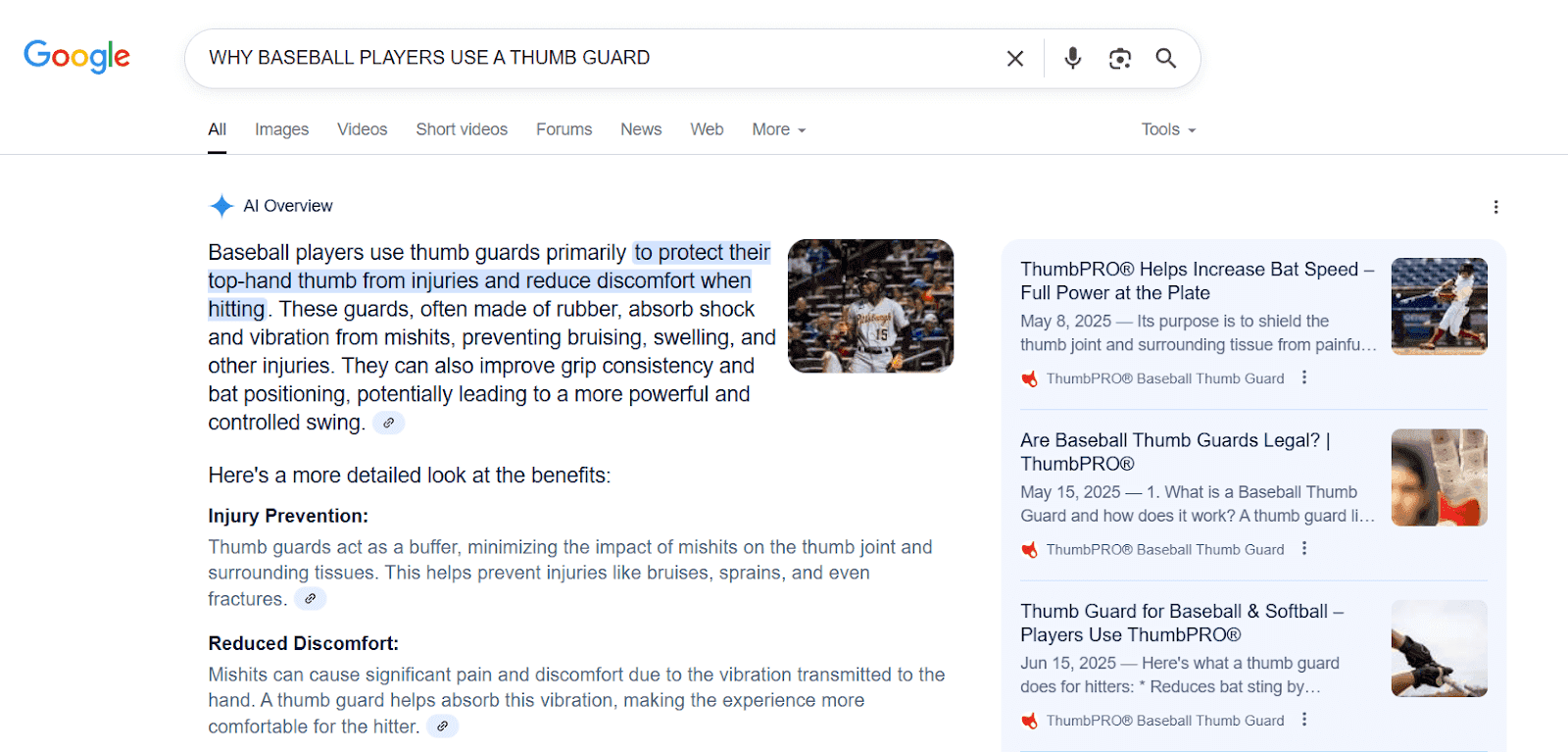
Other challenge participants who followed our checklist also had good results. MyKeysToMusic ranked for their posts discussing Nord Stage 4 vs. Nord Stage 3, and ParrotEssentials showed off a new post in Google’s AI Overview.
We decided to check how our challenge winners were holding up in AI search this year. Here’s what we found:
The winning post incorporates relevant subqueries in its main headings, which is why even after a year, Google’s AI Overview cites the content.
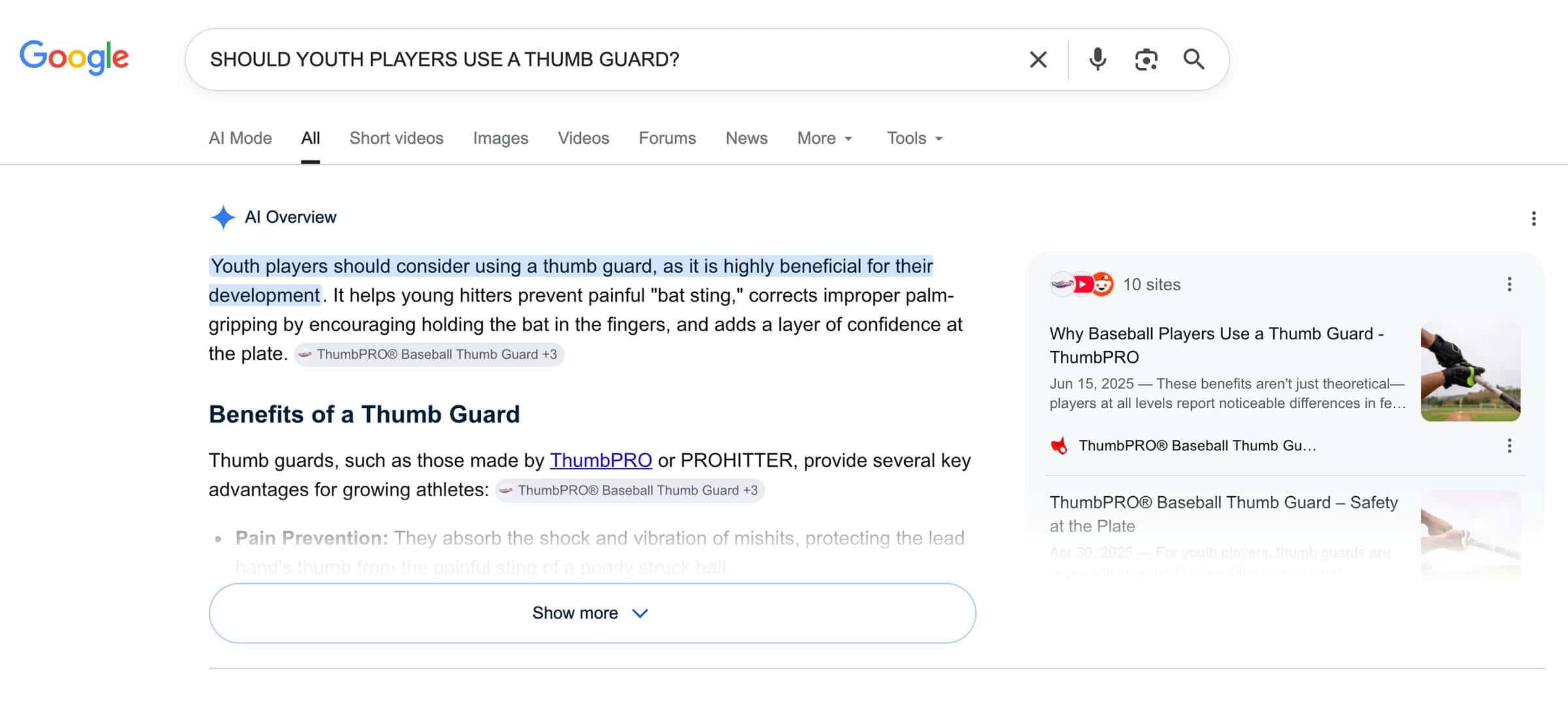
The challenge runner-ups remained relevant in AI searches. In 2026, ParrotEssentials gets citations in Perplexity, while MyKeysToMusic’s Nord Stage 3 vs. Nord Stage 4 comparison shows up in ChatGPT’s resources.
If you want to join the AI Optimization challenge, let us know. If we get enough participants, we’ll restart the challenge!
Prepare Your Content for AI-Based Searches
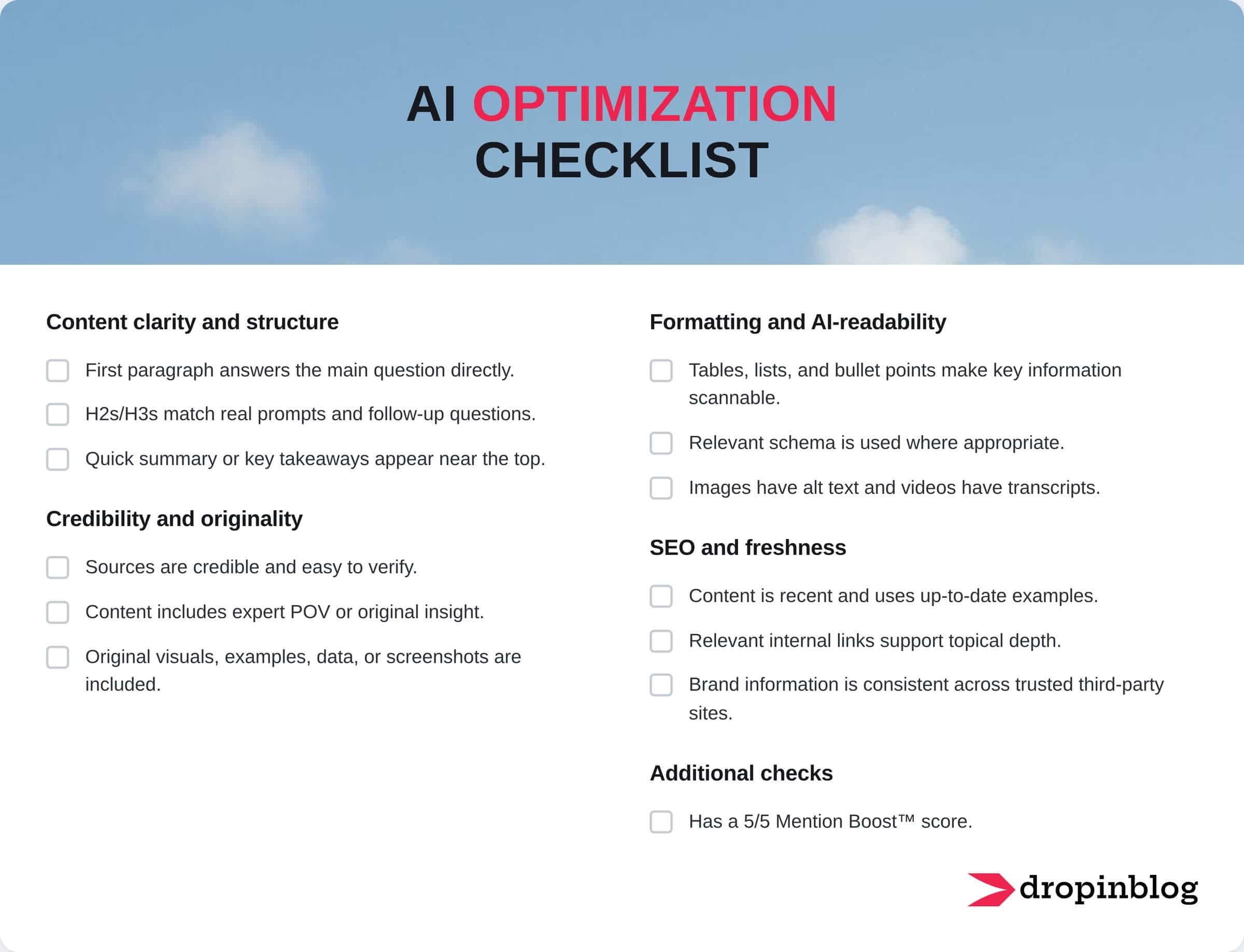
To improve your site’s chances of appearing in AI searches, review your existing content and do these six simple things today:
Read the intro paragraph. If it doesn’t answer what the blog post is about right away, rewrite it to offer a clear, direct answer.
Review the post’s headings and check if they reflect what each section covers. If they’re vague (e.g., introduction, final thoughts), rewrite them to make them more specific.
Check whether your content has a logical hierarchy and make sure it doesn’t skip levels, e.g., go from H2 to H4.
Think about the follow-up questions your readers might have. If your content doesn’t answer them, add new sections to cover these follow-up questions.
If a question doesn’t require a separate section, consider adding it to your blog post's FAQs.
Where possible, add a bullet list or a table to make the content easier to digest.
If your content talks about studies or data findings, make sure to add links to your sources.
If you'd rather not run this checklist manually on every post, our Mention Boost™ tool builds AI visibility checks directly into the DropInBlog editor.
By implementing these simple changes, you can turn your blog into a source of information that AI tools love to cite and mention.
And if you don’t have a blog yet, start blogging with DropInBlog today.