
Key Takeaways
- The best way to add a blog to your Duda site is with DropInBlog!
- The free trial and quick setup lets you to test it in a few minutes.
- DropInBlog has different pricing plans for individuals and teams.
In this guide, we’ll show you how to add a fully functioning blog to your Duda website by copying and pasting just a few lines of code.
The Duda website builder has a built-in blog you can find under Pages → Blog. It works for basic posts but lacks an SEO scoring tool, automatic Article/FAQ schema, and AI Overview optimization.
By using DropInBlog with your existing Duda website, you can add the SEO toolset Duda's native blog doesn't have in under five minutes.
Table of Contents
What's New in Duda for 2026
Duda shipped several 2026 updates that affect content workflows:
- Populate Template with AI: generates the entire site content from a client brief. Useful for first drafts, but the output needs human editing for ranking-quality content.
- Spot SEO tag gaps: a new scanner inside Duda that flags blog posts with missing titles or meta descriptions. Helpful for catching basics, but doesn't score content for ranking strength the way a dedicated SEO tool does.
- AI-powered image generation: in-editor image creation for blog headers and inline visuals.
- AI Widget Builder: natural-language custom widgets.
What Duda's native blog still lacks: keyword-based SEO scoring as you write, AI Overview/LLM optimization, automatic Article/FAQ/Video schema, and built-in topic discovery. Those are the gaps DropInBlog fills.
Why Duda Agencies Use DropInBlog for Client Sites
Most Duda users are agencies and freelance designers, not in-house marketers. DropInBlog fits agency workflows because:
- Clients edit blog posts in DropInBlog without touching the Duda site builder, so no risk of broken layouts
- White-label dashboards for agency clients (available on team plans)
- One DropInBlog account can power blogs across multiple Duda client sites
Schema, sitemaps, and SEO scoring are auto-applied, so clients see ranking improvements without you billing for retainer-level SEO work.
Comparison Table: Duda Native Blog vs DropInBlog
| Feature | Duda Native Blog | DropInBlog |
|---|---|---|
| SEO scoring as you write | No | Yes, SEO Analyzer in real time |
| Automatic schema | No | Yes (auto-applied) |
| White-label/agency dashboard | Limited | Yes (on team plans) |
| Multi-site management | No (one blog per site) | Yes |
| E-E-A-T author profiles | Basic (name + bio) | Detailed (photo, bio, expertise, social, slug) |
How to Add a Blog to Your Duda Site using DropInBlog
To get started, you’ll need to create a DropInBlog account, which you can easily do with a free trial. You’ll also need an existing Duda website.
Step 1. Create a Blog Page
Navigate to the Duda website builder, select Pages in the sidebar, and hit the New Page button to create a new blank page.
Alternatively, you can duplicate an existing page using the individual page settings. This saves you from having to create the whole page from scratch.
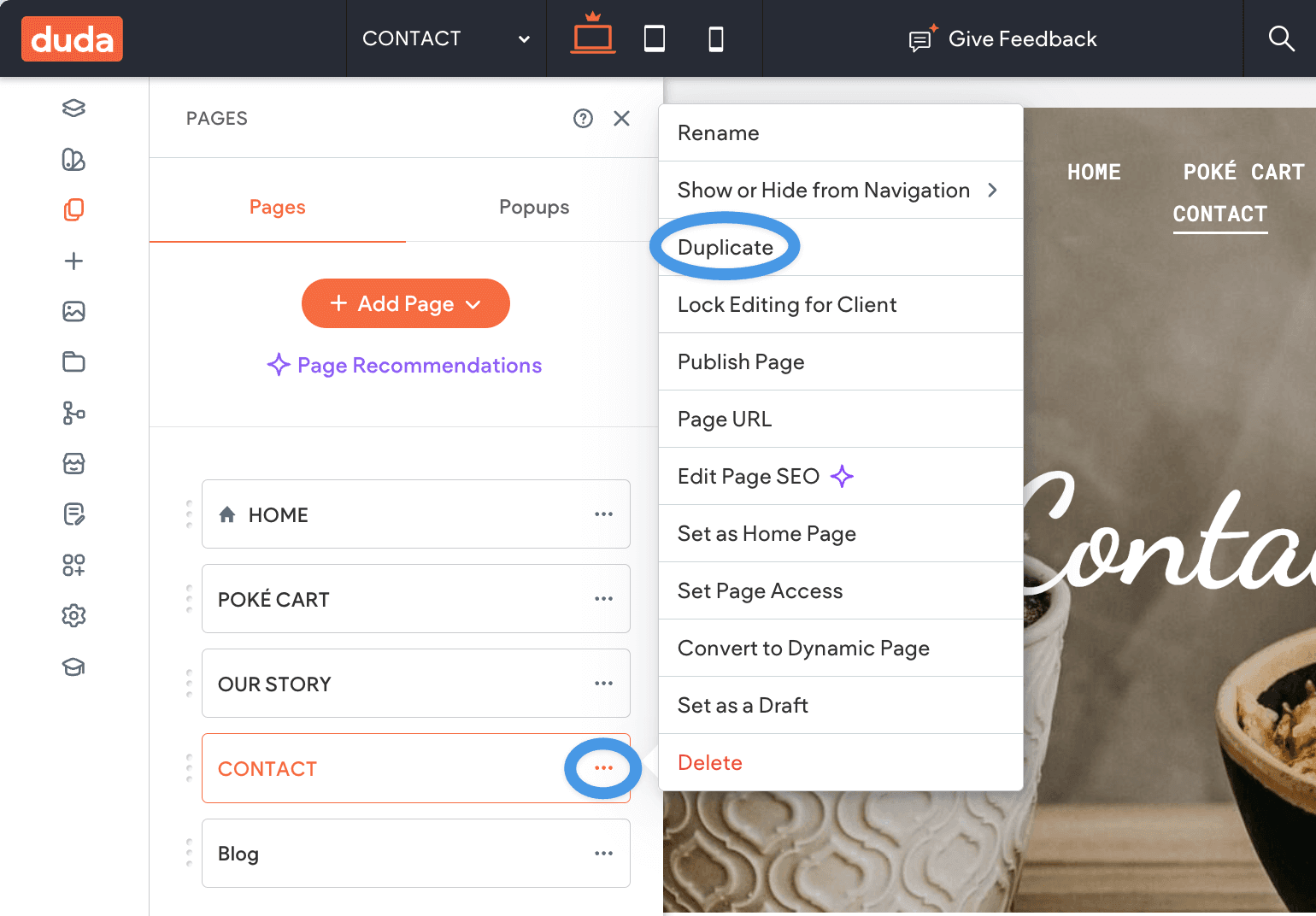
Name your newly created page; I’m going with the imaginative name of “Blog.”
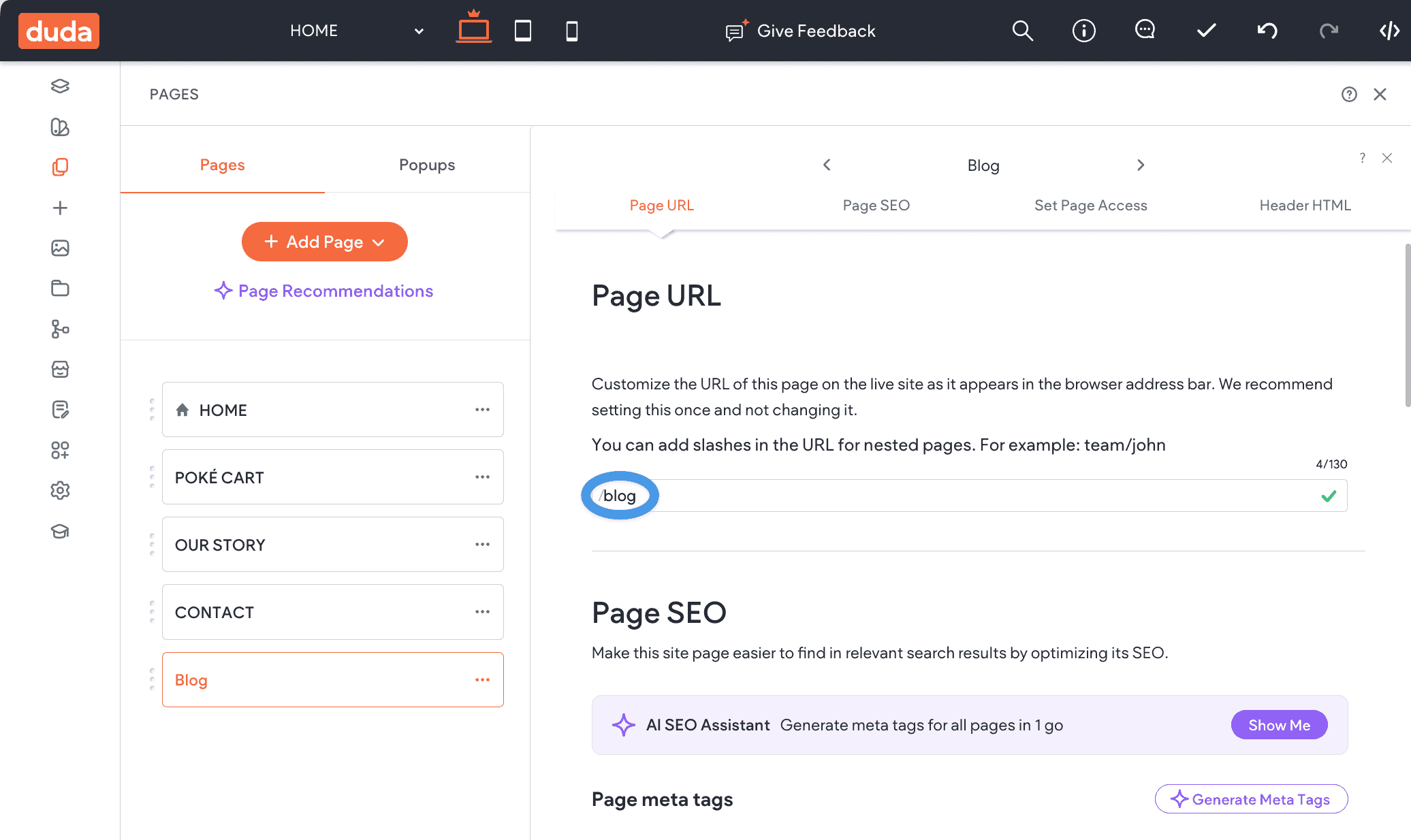
You’ll also need to set a page URL. You can do this by hitting the cog icon on the page item in the Pages sidebar and typing a value for the field titled Page URL. Again, I’m going to set my page URL to “blog.”
Step 2. Connect Your Accounts & Integrate the Blog Posts
Open the newly created blog page in the Duda builder and hit Widgets in the main sidebar. Locate the HTML widget and drag it onto your newly created page. Once the widget is dropped, the HTML Content editing area should automatically open.
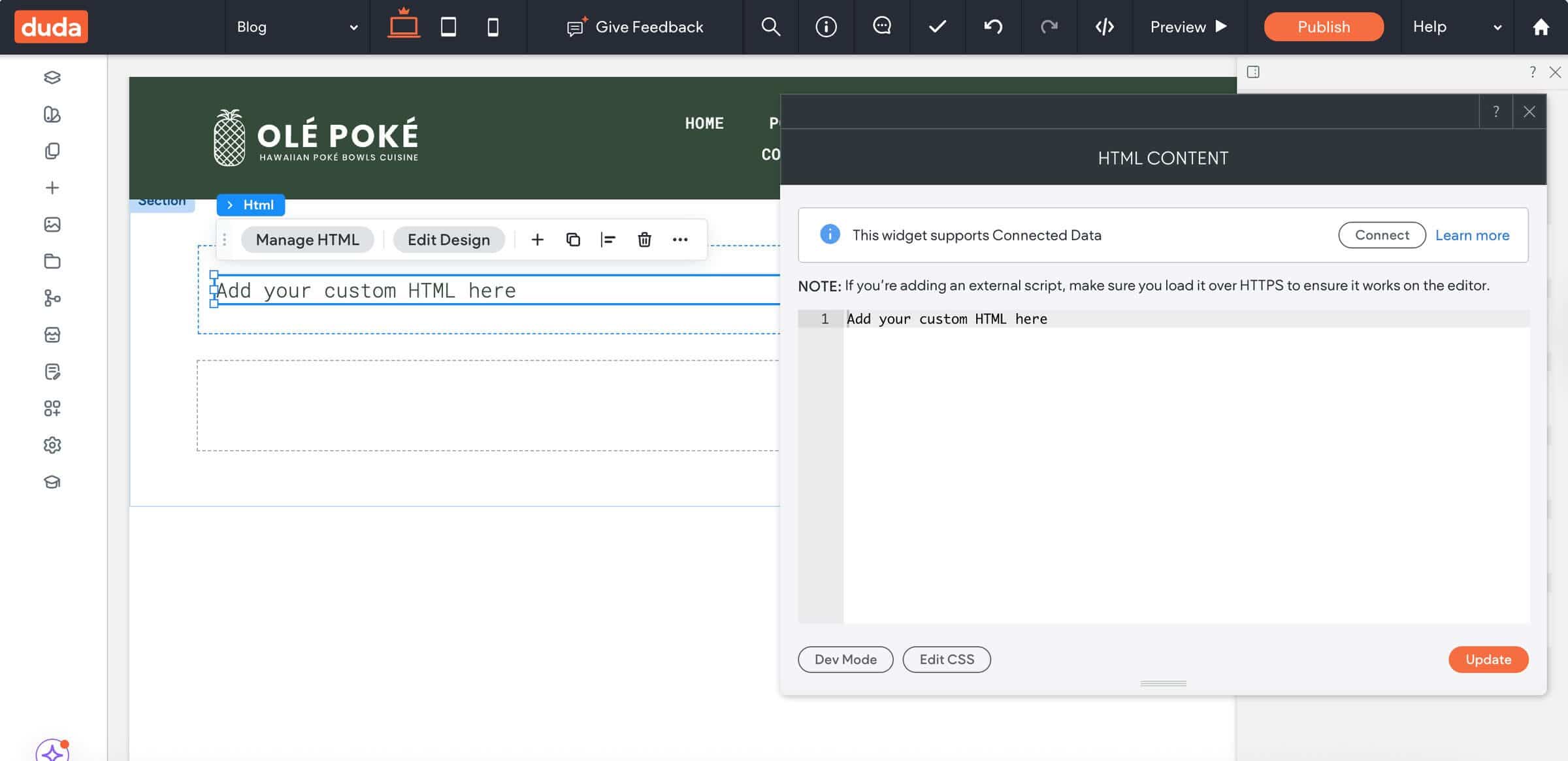
Next, open a new browser window and head on over to your DropInBlog account. Select Code & Layout from the main navigation. In the Blog Code steps, copy the code shown in Step 1 and Step 2, which looks something like this:
Step 1 Code:
<script src="https://io.dropinblog.com/embedjs/XXXXXXXXXXXXXXXXX.js"></script>Step 2 Code:
<div id="dib-posts"></div>Switch back to the Duda website builder and paste this code into the HTML Content text area popup. Click Update to save your changes.
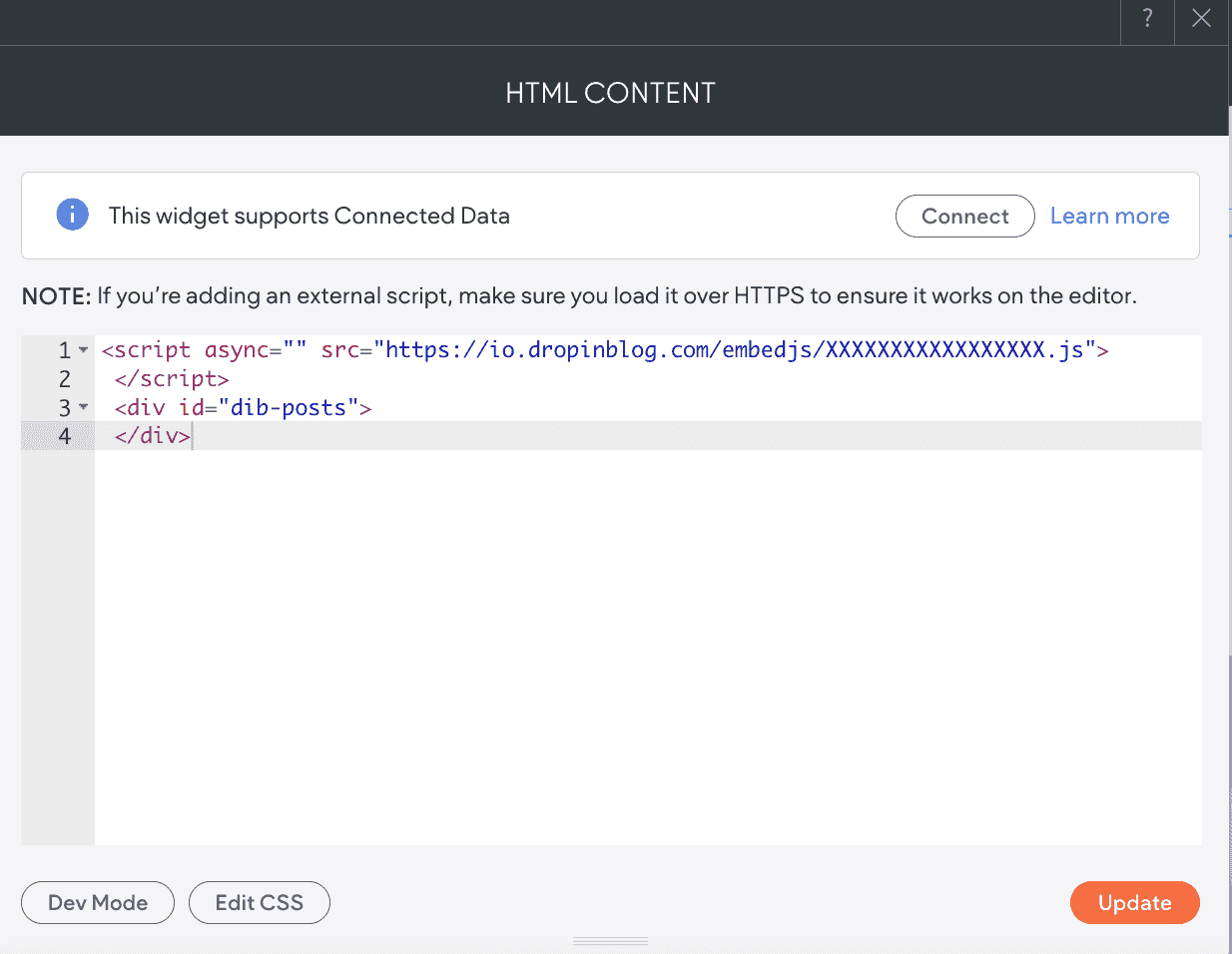
The next steps will be to publish your new page and set the blog page URL in DropInBlog.
Step 3. Publish your New Blog
Go ahead now and hit Publish in the top right corner of Duda. After that, Duda will publish your site changes and give you a link to your website. Copy the page address link and head back over to DropInBlog.
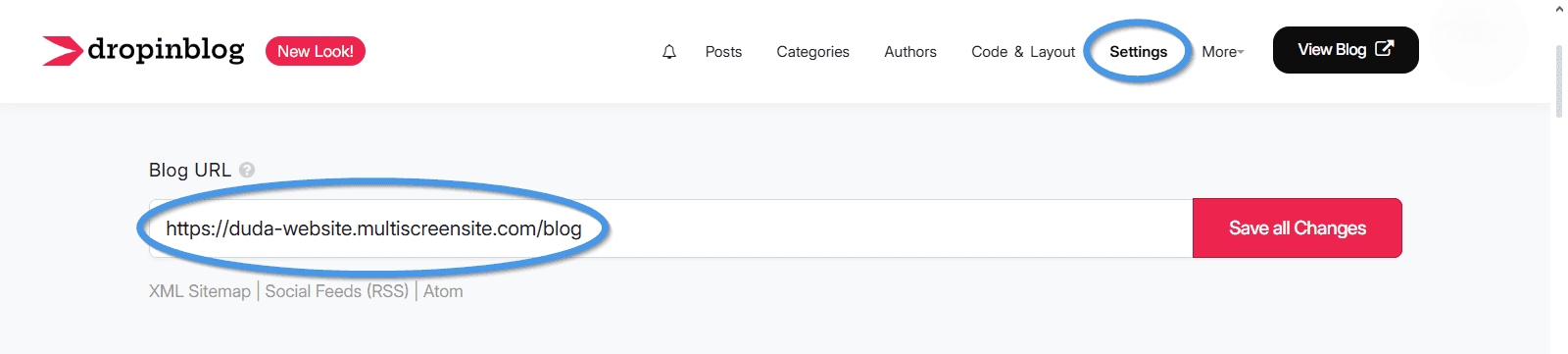
From within DropInBlog, select Settings from the main navigation. Locate the Blog URL field and add your full Duda blog page URL. This will be your website domain, followed by your page slug. For example, my site URL and page slug is: http://duda-website.multiscreensite.com/blog.
Make sure to hit Save All Changes in the DropInBlog settings.
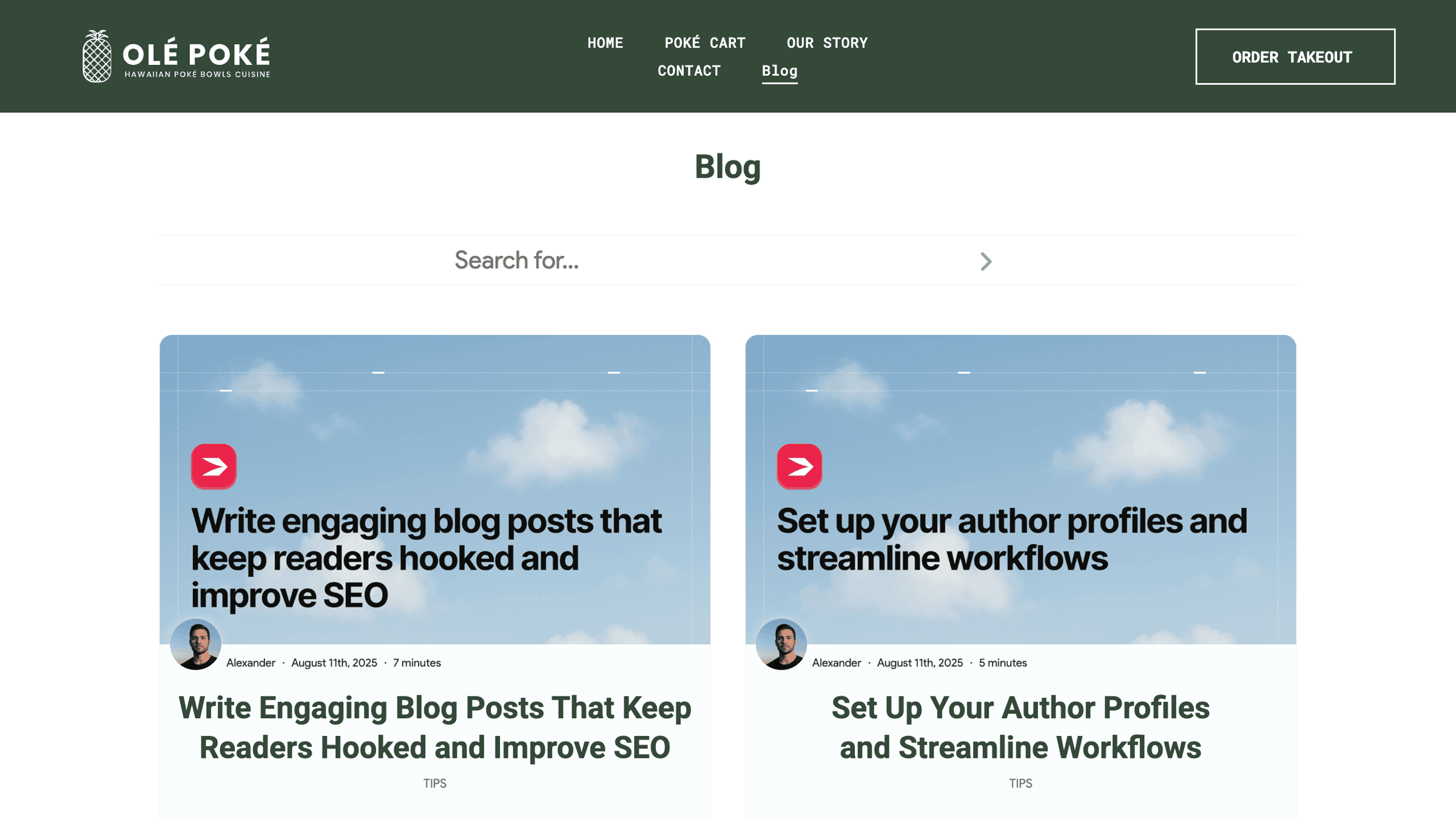
Congrats, all your hard work is now complete! It's time to navigate to your new blog page and test out your shiny, new fully-functioning blog! ✨
Tips for using Duda
Your newly created blog will automatically adopt the styling from your website and match your branding. However, you can add custom styles within Duda using another HTML Content widget on the page and add custom CSS. But remember that when using the HTML Content widget, you’ll need to wrap your CSS in style tags like this: <style>…</style>
FAQs
Can I start an SEO-friendly blog on Duda?
Duda does allow you to create and publish your blog posts. However, Duda isn’t going to give you optimal search-engine–optimized content. It simply doesn’t offer enough features without adding plugins or extensions. Luckily, DropinBlog can be easily integrated with your Duda website, and it includes an excellent SEO Analyzer tool.
Does Duda have a blog feature?
Yes. Duda has a built-in blog you can access under Pages → Blog. The native blog works fine for occasional content, but it lacks keyword-based SEO scoring as you write, automatic Article/FAQ/Video schema markup, and detailed E-E-A-T author profiles. DropInBlog is a more complete blog solution.
Is Duda better than WordPress for blogging?
For agency-built client sites, yes. Duda is built for managed websites where clients can safely edit content without breaking layouts, plugins, or themes. WordPress is built for full control by site owners willing to manage the maintenance burden (updates, security patches, plugin conflicts).
How do I add SEO to a Duda blog?
Duda's native SEO tools cover the basics: meta titles, meta descriptions, and canonical URLs. For deeper SEO, with real-time keyword scoring as you write, automatic Article/FAQ/Video schema markup, AI Overview/LLM optimization, and detailed E-E-A-T author profiles, install DropInBlog via Duda's HTML widget.
In Summary
Once your DropInBlog account has been integrated with Duda, there will be no need to use Duda to add new blog posts. You can now log in to DropInBlog to create new posts, and they will be automatically published on your Duda-created website!
If you'd like a hand connecting DropInBlog to your Duda site, please do get in touch. We are more than happy to help out.
Happy blogging!