

Weebly is still one of the easiest ways to build a website in 2026, but it’s no longer one of the most capable ones. It works well for simple sites and small businesses, but falls short if you need scalability, advanced SEO, or a blog-driven marketing site.
Let's explore Weebly’s pricing, features, pros and cons, alternatives, and use cases to help you decide whether Weebly is a good fit for your business.
Final Verdict: Is Weebly Worth It?
In 2026, Weebly still works for simple sites and small online stores in the markets where it operates, but Square is winding it down in 67 countries, so it's not a platform to build on long-term.
Since being acquired in 2018, Weebly has become a more powerful tool as it now integrates with Square.
Its main advantages are ease of use and low cost.
However, this same Square integration also creates confusion around Weebly vs. Square Online and how the two actually work together.
Weebly’s biggest limitations are its restricted design flexibility and scalability.
It fails to keep up with competitors when it comes to adding new features and integrations.
While it might be suited for small websites with simple designs, Weebly isn’t ideal for those looking for a website that supports modern tech stacks, advanced customizations, and a robust blogging engine.
If your site relies on content and blogging, upgrading Weebly’s built-in blog with a dedicated solution like DropInBlog is a more scalable approach.
Table of Contents
- Final Verdict: Is Weebly Worth It?
- Weebly Is Shutting Down in 67 Countries
- What Is Weebly?
- What Are Weebly’s Key Features?
- Weebly Pricing Overview
- Weebly and Square
- Strengths of Weebly
- Common Weebly Complaints
- Weebly vs. WordPress vs. Squarespace vs. Square vs. DropInBlog
- Weebly Alternatives
- Who Should Use Weebly?
- FAQs
- Is Weebly Right for You?
Weebly Is Shutting Down in 67 Countries
In June 2026, Weebly announced it is closing operations in 67 countries, citing "changes in regulation and to simplify global operations."
If you're in the US, UK, Canada, Australia, or most of Western Europe, your site is not affected. Weebly continues to operate normally in those markets.
If you're in one of the 67 affected countries, there's a firm timeline:
June 29, 2026: you can no longer publish new pages
September 27, 2026: your site is unpublished and goes offline
December 26, 2026: your account is closed and you lose login access
What it means if you're not affected. Weebly isn't disappearing in your market, but a company withdrawing from 67 markets at once is a clear signal about where the product sits in Square's priorities.
Combined with no meaningful feature releases in over a year and new users being routed to Square Online, it's a reasonable basis for not building anything long-term on Weebly, and a strong argument for keeping your content in a form you can move.
You can find the full timeline, export instructions, and domain transfer steps here.
What Is Weebly?

Weebly is a user-friendly site builder with e-commerce capabilities, and it’s now part of the Square ecosystem. It’s easy to navigate, and it doesn’t require coding skills to get results, which is why it’s so popular. It has a drag-and-drop editor and allows you to create anything from regular website pages to blog posts. And since becoming part of the Square family, Weebly now lets you connect your brick-and-mortar store to Square POS and start accepting orders online.
What Are Weebly’s Key Features?
Weebly offers a range of features for building websites and online stores. Below, we’ll explore the essential ones.
1. Easy-to-use Site Editor
One of Weebly’s core strengths is its intuitive page editor. On the left side of the editor, you’ll find a menu with some basic elements like text and images, as well as some more advanced ones, like RSVP forms, search boxes, and products.
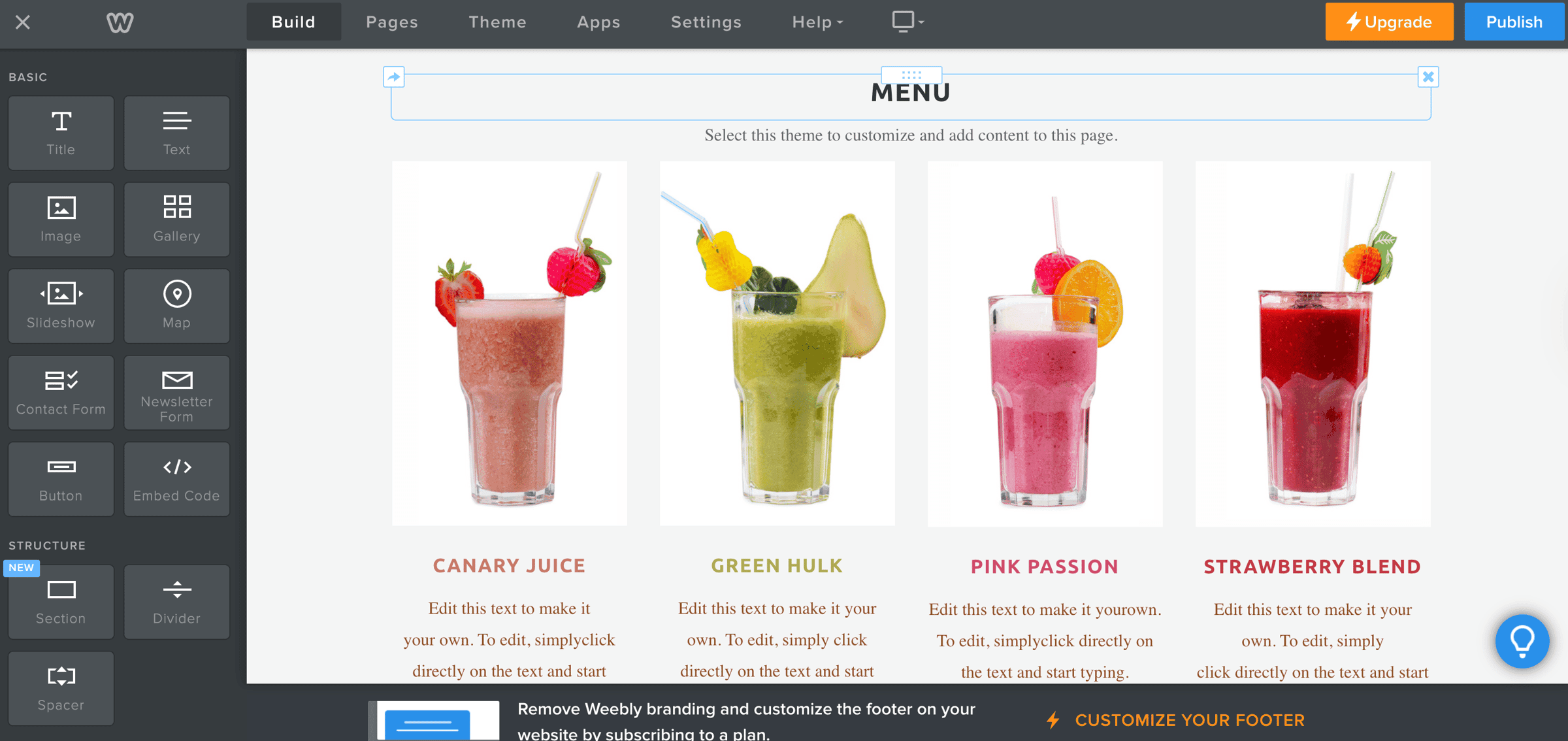
To help you build your site faster, Weebly also supports pre-built sections, including galleries, team, featured, and contact sections. All you have to do to add elements to your page is drag and drop them into the desired place – it’s very intuitive.
2. Blogging Features
If you want to create a blog on Weebly, you’ll find a handful of features that will allow you to easily build one. To start a blog, all you have to do is create a blog page. Weebly’s blogging tool supports comments, categories, and archives.
However, if you expect a traditional post editor, you won’t find that in Weebly. It applies the same philosophy to building blog posts as it does to building regular site pages.
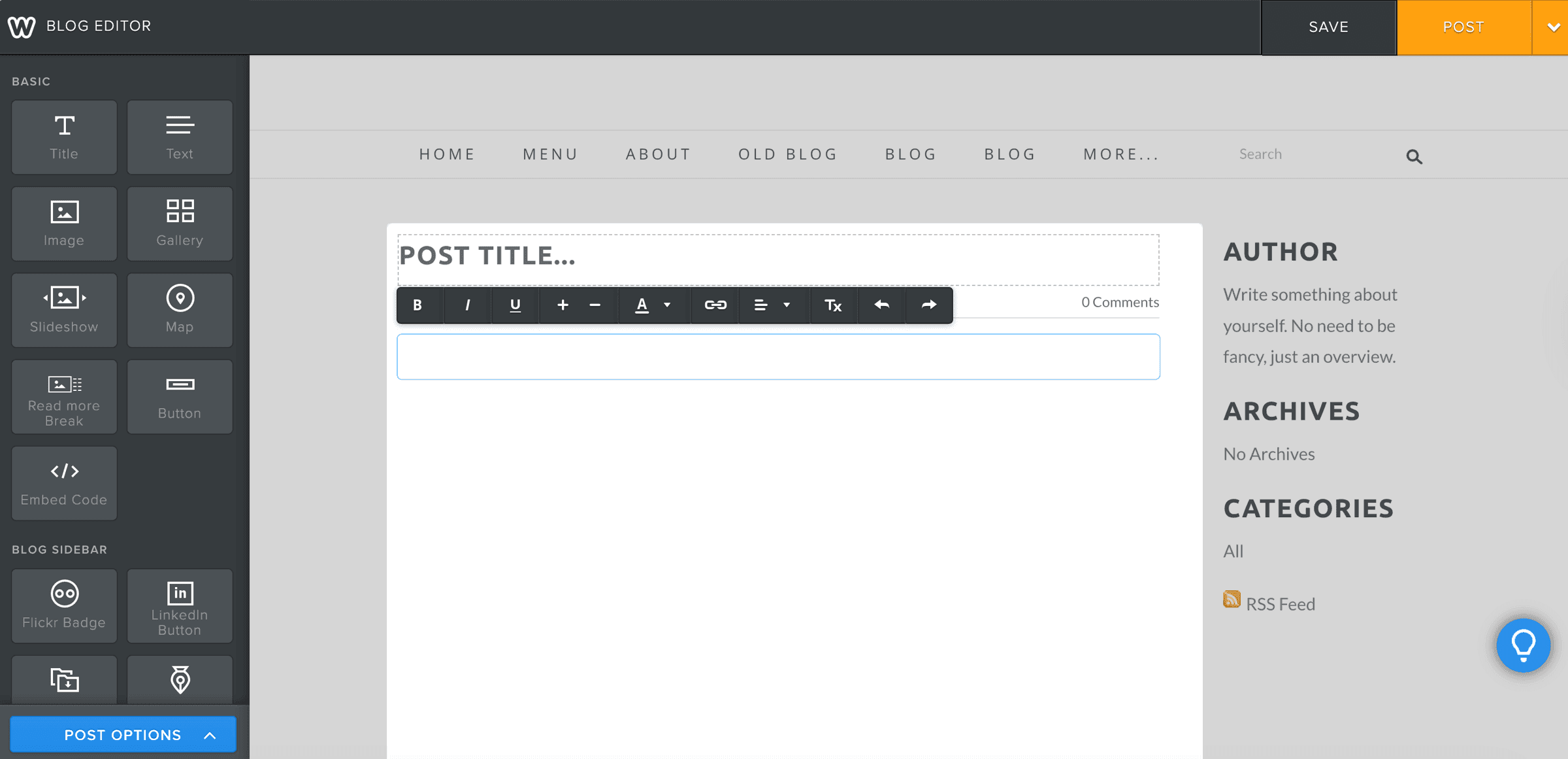
The left-hand side menu stores all the elements you’ll find in the traditional editor, and a few more blog-specific elements. So, to create a post, you have to actually drag and drop elements onto the page – which isn’t the experience you’ll get from blogging tools like DropInBlog or WordPress.
The text editor supports some basic styling and formatting options, while other elements you can add to your post include images, videos, and newsletter forms. You can also create simple author boxes and fill out some basic SEO fields, like the title tag and meta description.
The obvious downside is that creating blog posts this way takes time, and there’s no centralized dashboard where you can view all your blog posts.
In practice, Weebly’s blog feels like building a web page, not publishing content, which makes it slow and hard to scale.
If blogging is an essential tool in your marketing arsenal, you should try Weebly’s alternatives for your blog. DropInBlog seamlessly fits within your Weebly site and brings advanced SEO features to the table.
3. E-commerce and Square Integration
One of Weebly’s stronger suits is its integration with Square. Thanks to this integration, you can easily create and sell physical and digital products, add variants, assign products to categories, and optimize your product pages for search engines.
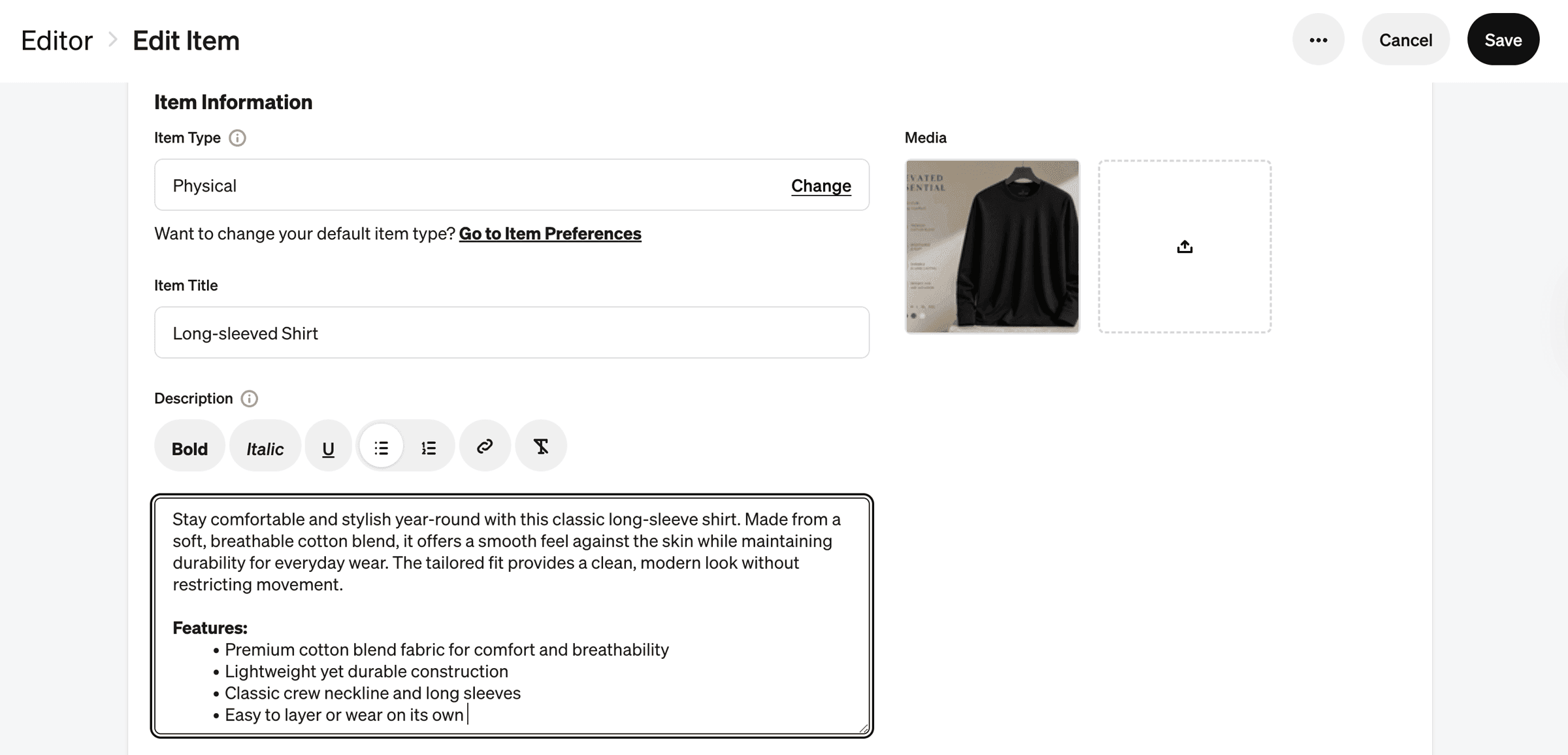
Apart from this, you can connect your account to Stripe and PayPal to receive payments, set your shipping address, track your orders, and set tax rates. You can even send abandoned cart emails and access your store’s sales reports.
However, Weebly’s e-commerce capabilities can’t compare to dedicated e-commerce platforms like Shopify. It’s built for small businesses and works well for simple setups.
4. Themes and Design
There are over sixty free Weebly templates or “themes,” as the platform calls them. They all look professional and are customizable, responsive, and beautifully designed.
The Weebly themes are grouped into six categories according to how they’re meant to be used. This is just a glimpse of what Weebly offers in this domain:
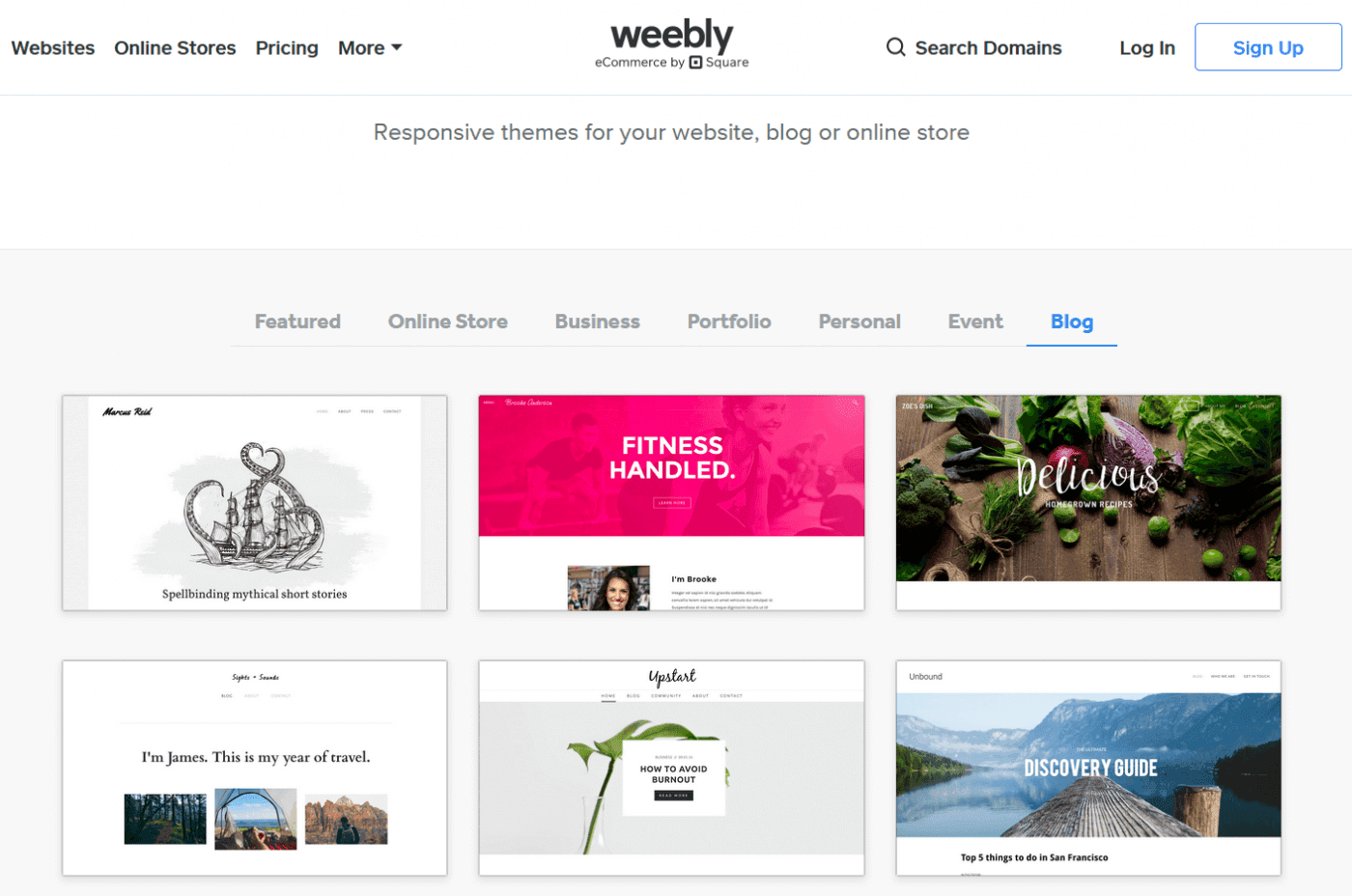
So, if you want to create a website in a few clicks with one of the pre-built templates, Weebly can help you with that.
5. App Center and Extensibility
If you want to add some features to your Weebly site, you can use the platform’s App Center. It features over 380 apps, ranging from e-commerce to marketing and communication apps.
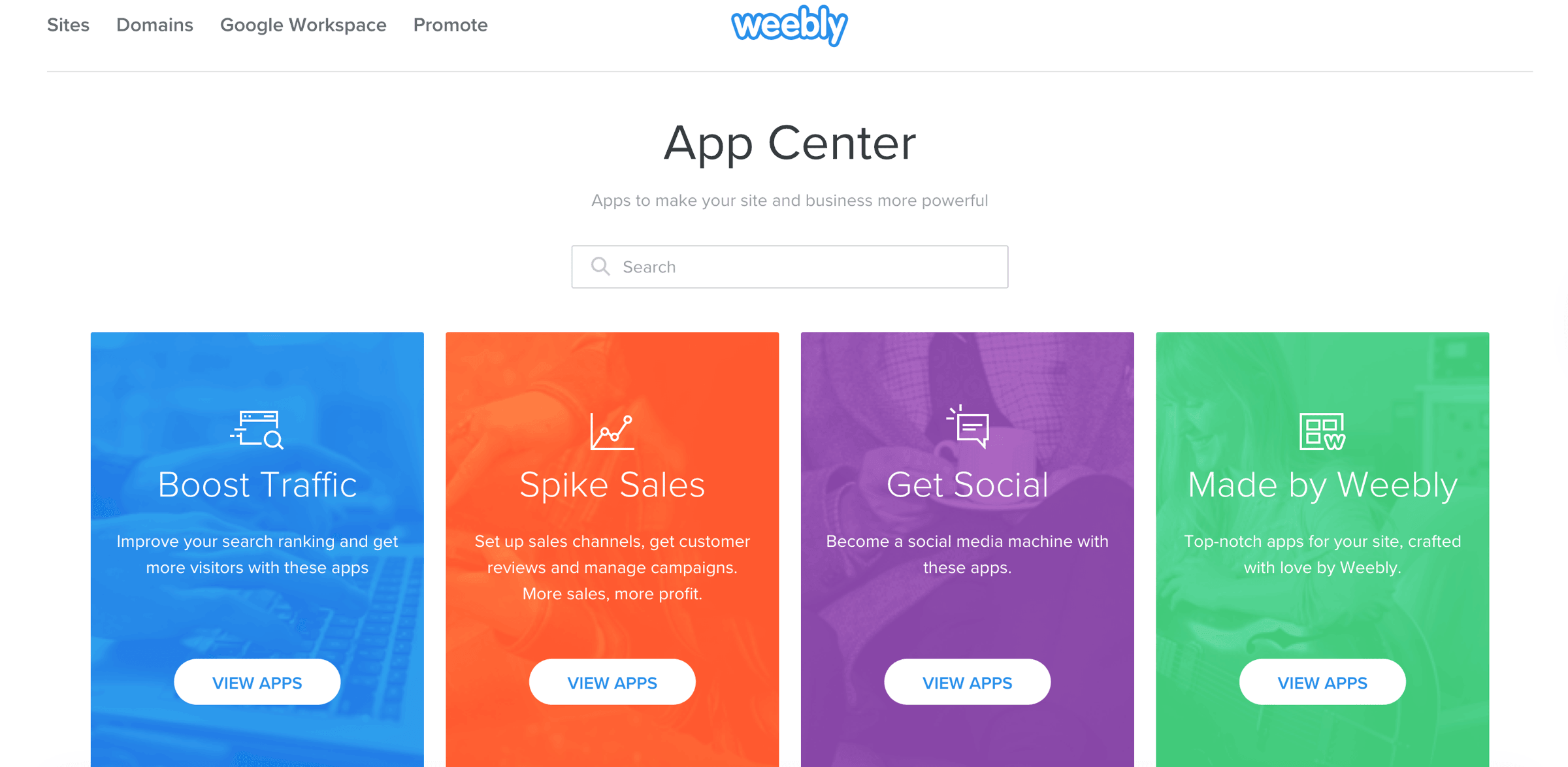
Some apps are designed to “fix” Weebly’s limitations. For example, Weebly doesn’t support the option to add headings to your content, which is why you’ll find an app designed only for that.
Other apps are focused on extending what you can do with your Weebly site, so you’ll also find shipping management, membership, and live chat software in the App Center.
The app's offerings aren’t that extensive, but there are still enough choices to enrich your site. The biggest downside in the app arena is that Weebly doesn’t integrate with Zapier, which could significantly expand its integration pool.
6. Code Editor
When it comes to code editing, Weebly gives you the option to customize your theme code. While you don’t have full control over your theme’s HTML and CSS, there are still quite a few adjustments you can make.
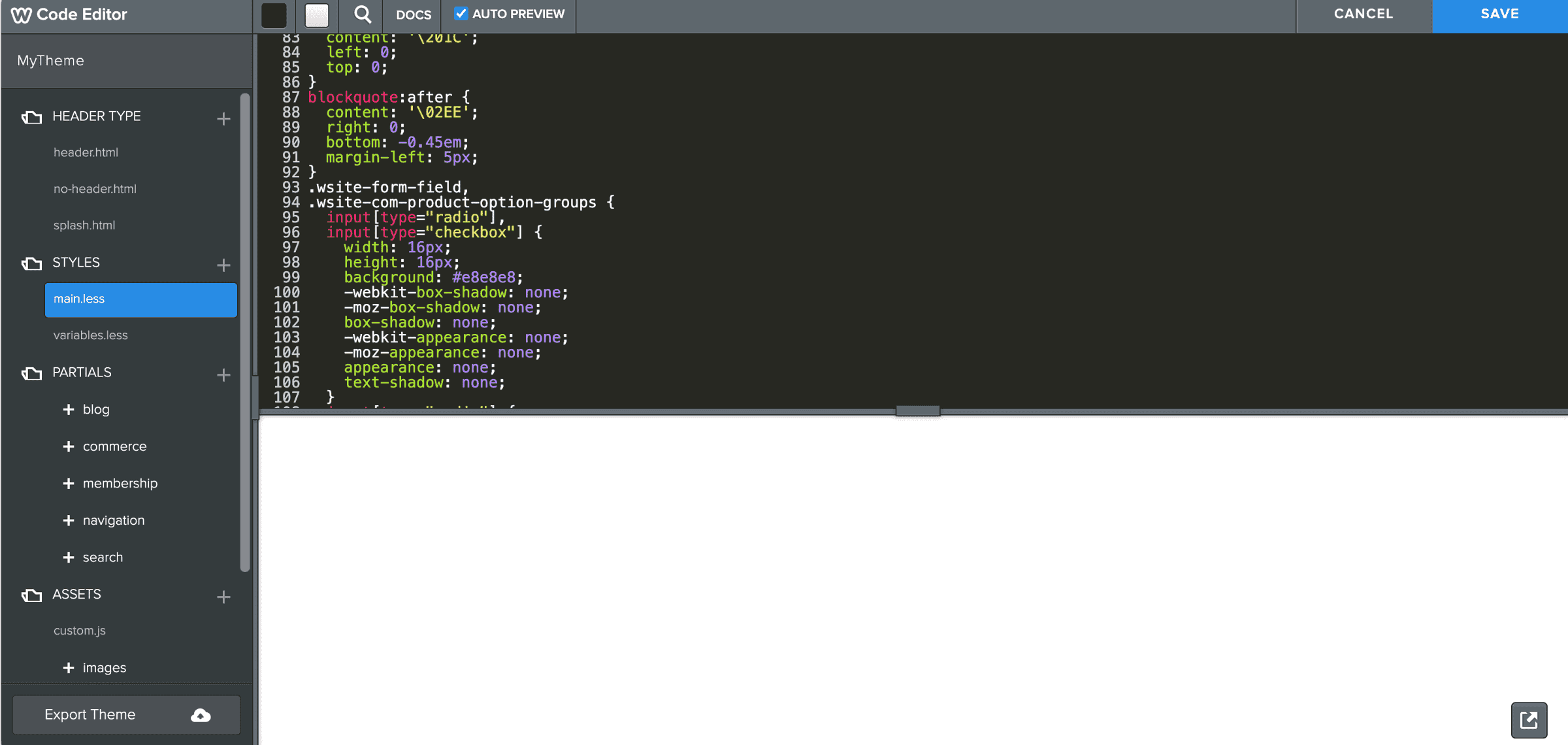
You can customize your site’s header and footer area, rearrange template sections, and change your site’s design via CSS.
Additionally, if you want to add code from third-party apps, you can use Weebly’s Embed Code element.
7. SEO Basics
When it comes to SEO, Weebly offers standard options to optimize your website. You can add metadata, customize URLs, and manage 301 redirects from the settings page.
Since Weebly has built-in SEO support, you don’t need an external app to help search engines find your site more easily – or at least not necessarily. We say that because most of these features are quite standard, while more advanced ones, like blog schema support, would require a third-party app.
Weebly Pricing Overview
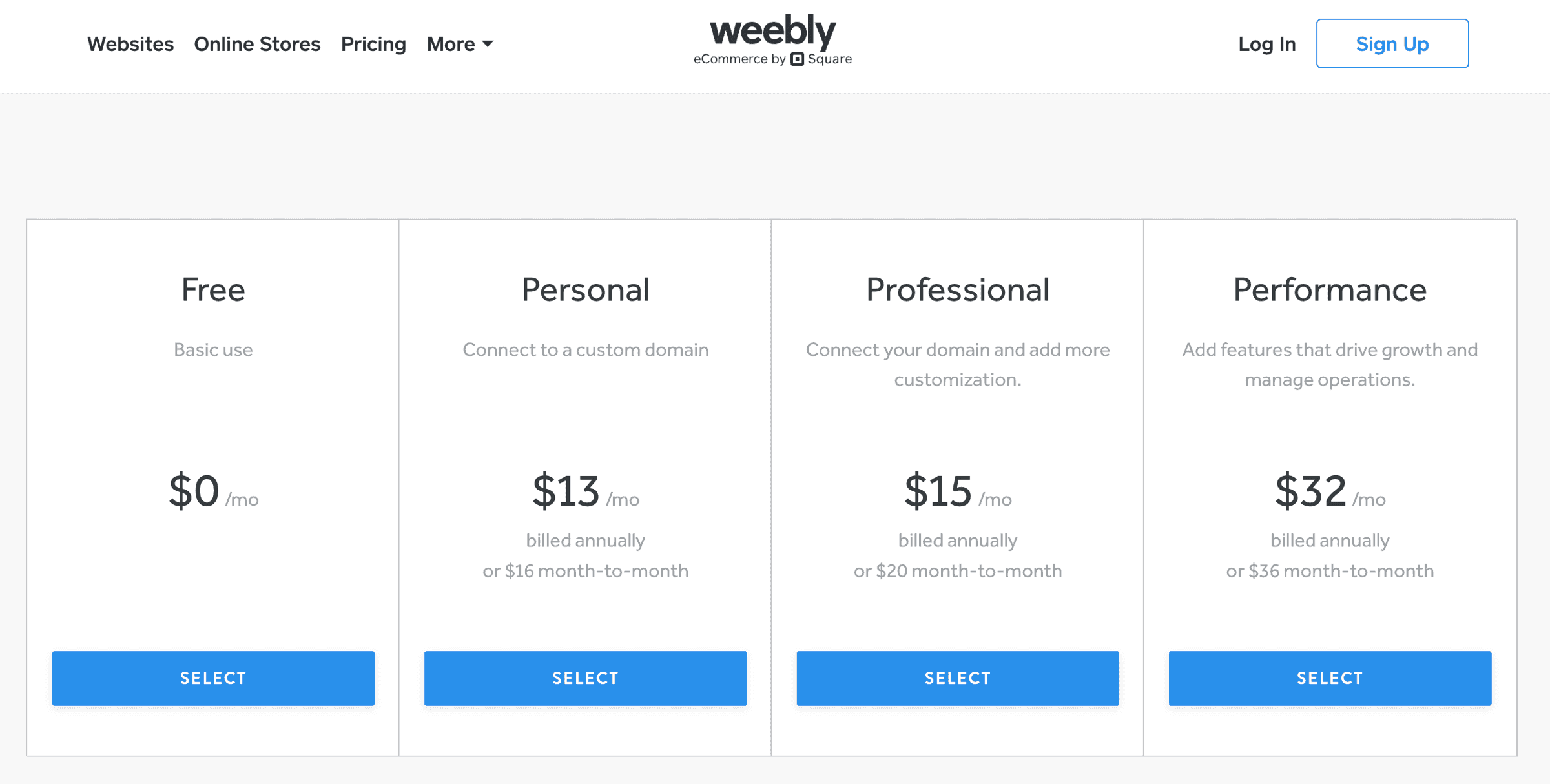
Weebly has four pricing plans, and even the most expensive one remains an affordable option. Here’s what you get with each plan:
Free: This plan lets you launch your website and online store at no cost. It even lets you create an unlimited number of physical products, manage your inventory, and set up in-store pickups. Still, it doesn’t support custom domains or digital products. For that, you’ll need the Personal plan.
Personal: Apart from the option to use a custom domain and sell digital products, this plan lets you set shipping rates for your store’s physical products based on price and weight, or offer flat-rate shipping. It also supports shipping labels and phone support. It costs $16/month with a monthly subscription or $13/month with an annual subscription.
Professional: With this plan, you can remove Weebly’s branding and storage limits, and access advanced site analytics, but this plan offers the same e-commerce features as the Personal plan. The price of this plan stands at $20/month or $180/year.
Performance: Weebly’s highest-tier plan offers advanced e-commerce features, including abandoned cart emails, PayPal payments, and item reviews. Additionally, the analytics tool offers more e-commerce metrics, and, as with all top-tier plans, you get priority support. This plan is priced at $36/month, but you can get it for $32/month with a yearly subscription.
Pricing Reality Check
Weebly is an affordable option, especially since you can create a website and sell products online without any costs. The real question, though, is whether the low price tag comes with the features your website needs.
For small business owners who need a simple website with e-commerce functionality, Weebly is definitely worth the price.
However, for content marketing sites, Weebly isn’t the best option as its SEO and blogging features are somewhat limited. To bridge this gap, they’ll need third-party apps, such as a specialized SEO tool or a professional blogging app like DropInBlog, to get Weebly to work for them. Adding these apps increases the initially low cost, but that still doesn’t mean Weebly’s not worth the price.
If you look at Weebly’s competitors, such as Wix and Squarespace, you’ll notice that SEO and blogging aren’t their strongest suits either, and the pricing is similar. So, it all comes down to how comfortable you are with using Weebly. If you like working with its drag-and-drop editor, and you don’t mind limited design options, Weebly can be a good fit for your marketing site.
Weebly and Square
Square is a mobile payment system that lets you accept card payments and is one of the most widely used point-of-sale systems. With the Weebly integration, Square expanded its offering to online commerce. To compete with the big names in the e-commerce industry, Square launched Square Online – a website builder that’s powered by Weebly’s software.
This brings us to Square Online and how it is different from Weebly’s site builder.
Weebly vs. Square Online
Below are the most notable differences between Weebly and Square Online:
Square Online isn’t a drag-and-drop website builder like Weebly. It works on a point-and-click principle, which, according to Weebly users, isn’t as intuitive.
You can’t use it to access Weebly’s App Center. Instead, it has its own marketplace – the Square App Marketplace.
It offers considerably fewer customization options, although its pre-built themes look great out of the box.
Unlike Weebly, Square Online doesn’t have a code editor, but it lets you add custom code via the embed code option.
It doesn’t let you resize content elements, but it automatically adjusts their size based on the amount of page content and how it’s ordered.
It doesn’t include a proper blogging solution. Instead, there’s a functionality called Stories that you can use to emulate a blog, but it’s far from a full-fledged blogging app.
Square Online is more commerce-focused, while the classic Weebly editor offers more flexibility for general website building.
With the Square acquisition, knowing which of these two site builders you’ll get isn’t that obvious. So, when signing up for a Weebly account, you need to pay attention to this screen:
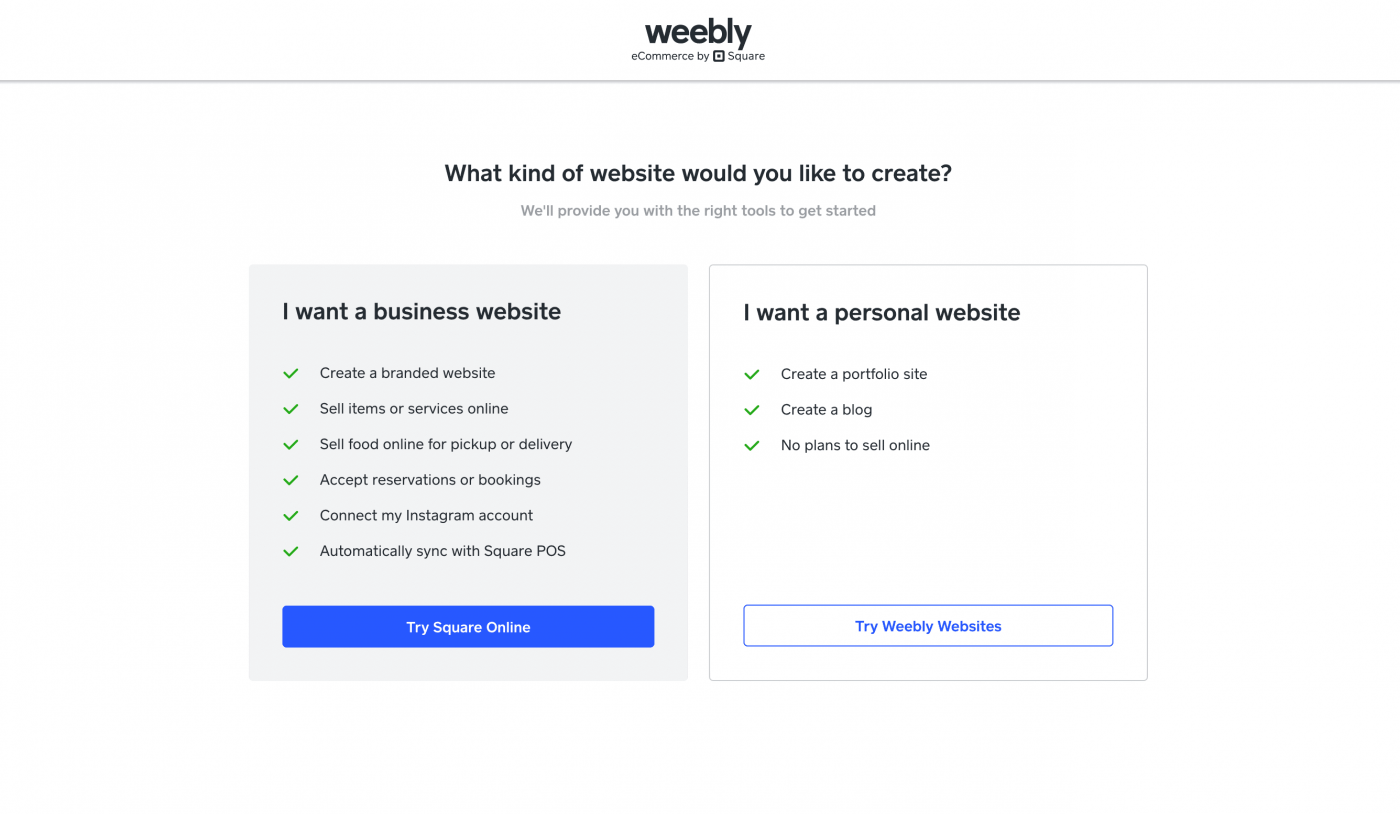
If you choose “Try Square Online,” you’ll get the Square Online builder, while the other option, “Try Weebly Websites,” will direct you to the familiar Weebly editor.
We signed up for a new Weebly account through Weebly’s official website to test this out. After creating a Weebly account, we built both a standard website and an online store using the Weebly builder. We could access and edit both websites in the Weebly editor.In our testing, the Weebly editor is still accessible, but the onboarding flow increasingly pushes new users toward Square Online. For now, Square has made it clear that your existing Weebly site will be saved in your account.
Strengths of Weebly
1. Fast Setup for Simple Websites
Weebly’s biggest strength is how quickly you can build a basic site. The editor is beginner-friendly, the page elements are easy to find, and the drag-and-drop layout makes it possible to create a working site without technical experience.
This makes Weebly a good fit for small businesses, service providers, portfolios, and simple online stores that need to get online quickly.
2. Affordable Pricing
Another highlight of Weebly sites is their low price and a generous free plan. The free plan gives users a low-risk way to test the platform, while the paid plans remain affordable compared with many modern website builders.
That makes it appealing for users who need a basic website but do not want to commit to higher monthly software costs from day one.
3. Square Integration for Small Sellers
Weebly is especially useful for small businesses that already use Square. The integration makes it easier to connect online selling with payments, inventory, and basic store management.
It is not as powerful as Shopify for larger e-commerce businesses, but for simple stores and local businesses, the Square connection is one of Weebly’s clearest advantages.
4. Some Code Access for Extra Customization
Although it's not very flexible in the design department, Weebly still lets you access its code editor. From here, you can make edits to your theme’s HTML and CSS, which gives you enough room to customize your site’s design to some degree.
This does not make Weebly a fully flexible platform, but it does give it more customization potential than a completely locked-down builder.
Common Weebly Complaints
1. Confusing Relationship with Square Online
After Square acquired Weebly, there has been a lot of confusion about how the two companies will work together. Weebly has its own editor, and Square launched its own based on Weebly’s technology – but the two are very different.
For new users, it is not always obvious which product they are choosing or which editor they will end up using. That makes the onboarding experience more confusing than it should be.
2. Limited Design Flexibility
Weebly is easy to use, but that simplicity comes with limits. Compared with platforms like Webflow, Wix, or Squarespace, Weebly gives users less control over layout, design behavior, and advanced customization.
It works well for simple sites, but users who want a more modern or highly branded website may find it restrictive.
3. Basic Feature Offering
While Weebly offers a decent set of features for creating, designing, and optimizing your website for search engines, it doesn’t suit every type of website. For instance, content marketing sites that need a robust blogging tool will find Weebly lacking.
Weebly covers some basic SEO features, but more advanced optimization often requires third-party apps. To access more advanced features, you’ll need a third-party app. The same applies to blogging since Weebly’s native blog is rudimentary. If you want to upgrade your blogging experience, you’ll need an external tool like DropInBlog.
4. Uncertain Product Improvements
Weebly shares development resources with the rest of Square's portfolio, and the evidence suggests it isn't getting many. No meaningful features have shipped in over a year, the mobile app has been pulled, new users are routed toward Square Online, and Square's own support pages advise Weebly users to switch to Square Online for the most up-to-date features.
The June 2026 announcement that Weebly is withdrawing from 67 countries removes most of the remaining ambiguity. Weebly is being maintained, not developed.
Weebly vs. WordPress vs. Squarespace vs. Square vs. DropInBlog
Now that you’re familiar with Weebly’s strengths and weaknesses, you should explore its alternatives because some of them might better fit your business model.
| Weebly | WordPress | Squarespace | Square | DropInBlog | |
|---|---|---|---|---|---|
| Ease of use | High | Low-moderate | Moderate | Moderate | High |
| Blogging features | Basic | Advanced (via plugins) | Basic | Basic | Advanced (built-in) |
| SEO | Basic | Advanced (via plugins) | Basic | Basic | Advanced (built-in) |
| E-commerce features | Basic | Advanced (via plugins) | Basic | Advanced | Depends on your main site |
| Integrations | Limited | Extensive | Broad | Broad | Broad |
Weebly Alternatives
If Weebly doesn’t fit your needs, the right alternative depends on what you’re optimizing for: flexibility, design, e-commerce, or content. Below, you’ll find an alternative for each of these goals.
1. WordPress
If you’re looking for a flexible website builder, WordPress can be a great option. Compared to Weebly, it’s much more flexible in every aspect – from design to features. This is thanks to its extensive plugin system, which allows you to extend your site’s built-in functionality.
When it comes to scalability, WordPress is also better than Weebly because it can handle more traffic, features, and content. Its strength lies in a flexible infrastructure that you can tailor to your site’s requirements.
2. Squarespace
Squarespace is another Weebly alternative, primarily because of its impressive template library. The pre-built templates look modern and clean out of the box, so you don’t have to do much to launch a visually appealing website.
Compared to Weebly, it offers a more flexible editor and more visual tools and effects you can implement without writing code. You can place site elements freely within a grid and fine-tune spacing, which beats Weebly’s restrictive column-based positioning.
So, if you want a website builder with a more flexible design editor, you should try Squarespace.
3. Square Online
If you’re on the edge of switching from Weebly’s website builder, Square Online may be worth considering if e-commerce features are your priority. It’s also a better fit if you want to sell both in person and through an online store.
Square offers more advanced commerce tools than Weebly, including customer accounts, fraud controls, retail preorders, and stronger POS integration. It also has a free plan, but keep in mind that Square’s paid plans are significantly more expensive than Weebly’s, especially if you need its higher-tier features.
4. DropInBlog
DropInBlog is a professional blogging solution that works with Weebly sites, and for that matter, any website. It’s not a substitute for your Weebly site, but an effective way to upgrade Weebly’s native blogging experience. So, if you want to upgrade your blogging game without leaving Weebly, DropInBlog can help you do that.
It offers the features you’d expect from a dedicated blogging tool, such as a powerful content editor, categories, and E-E-A-T-friendly author profiles. It also goes a step further in helping you optimize your content for search engines with its SEO-scoring tool.
Apart from these features, DropInBlog offers many more features designed to enhance content-oriented websites, including an AI-powered content planning tool, a text-to-speech engine, and more.
Start your DropInBlog free trial today
In short:
Choose WordPress for flexibility and scale.
Choose Squarespace for design.
Choose Square Online for selling.
Use DropInBlog if you want to improve blogging without leaving Weebly.
Who Should Use Weebly?
Whether Weebly is a good fit depends less on features and more on how you plan to use your site.
Weebly May Be for You If:
You want a simple website or small online store without a steep learning curve.
You value ease of use over flexibility and customization.
You’re already using Square and want a basic website and commerce in one place.
You don’t plan to rely heavily on blogging or SEO-driven content.
You want a low-cost or free way to get online quickly.
Weebly Is Not for You If:
Design flexibility is your primary concern.
You need advanced blogging and SEO features.
You have a large website or store catalog.
You rely heavily on integrations and automations.
FAQs
Is Weebly still worth using in 2026?
Weebly’s still worth it if you want to quickly launch a simple website or an online store. Its beginner-friendly editor and a free plan make it a tempting option even in 2026.
Is Weebly good for blogging?
Weebly can be a good blogging solution if you have a small blog and don’t post regularly. However, if blogging plays an important role in your content marketing strategy, you should either upgrade Weebly’s native blog through the DropInBlog integration or host your blog elsewhere.
What is the difference between Weebly and Square Online?
Weebly is a drag-and-drop website builder with e-commerce features currently managed through Square Online. Its focus is on helping you create a website. Square Online is a website builder powered by Weebly’s software. Its core focus is on helping you launch an online store, and compared to Weebly, it offers a lot more e-commerce features.
Is Weebly good for small businesses?
Yes, Weebly is a good website builder for small businesses, especially those on a tight budget. Thanks to its user-friendliness and decent template offering, small businesses can launch a website in just a few minutes.
Does Weebly have good SEO?
Yes, Weebly covers some SEO basics and allows you to optimize your site for search engines through meta tags, 301 redirects, and customizable URLs. If you need some more advanced features, you’ll have to explore its integrations or look for another platform that offers more in the SEO department.
Is Weebly better than Squarespace?
Weebly can be better than Squarespace if your goal is to create a simple website for free. It’s also much easier to use, but Squarespace has a wider pool of integrations and more beautiful templates.
Can I add a better blog to an existing Weebly website?
Yes, you can add DropInBlog to your existing Weebly website. The integration is straightforward and provides you with advanced blogging features, such as a flexible content editor, comprehensive author pages, and as-you-type SEO suggestions.
Is Weebly Right for You?
Weebly is still a practical choice for small businesses and individuals, especially if you value ease of use and low cost, and the merger with Square gives it a real boost in the e-commerce space. But it’s not built for modern content-driven sites or long-term scalability. If blogging, SEO, or content marketing are central to your strategy, you’ll either outgrow Weebly or need to extend it with more specialized tools.
Ultimately, the right choice comes down to how you plan to use your site. If simplicity is your priority, Weebly can get the job done, but if your goal is growth, you’ll want something that can grow with you.